
For Nigerians and Africans living in the UK, safety is not just a policy issue, it’s a lived reality. Whether it’s your sister walking home at night, your friend in a relationship, or your daughter growing up in a new country, conversations around protection, respect, and accountability matter deeply. At Chijos News, we bring these stories closer to home breaking down national campaigns in a way that speaks directly to diaspora communities navigating life, culture, and safety in the UK.
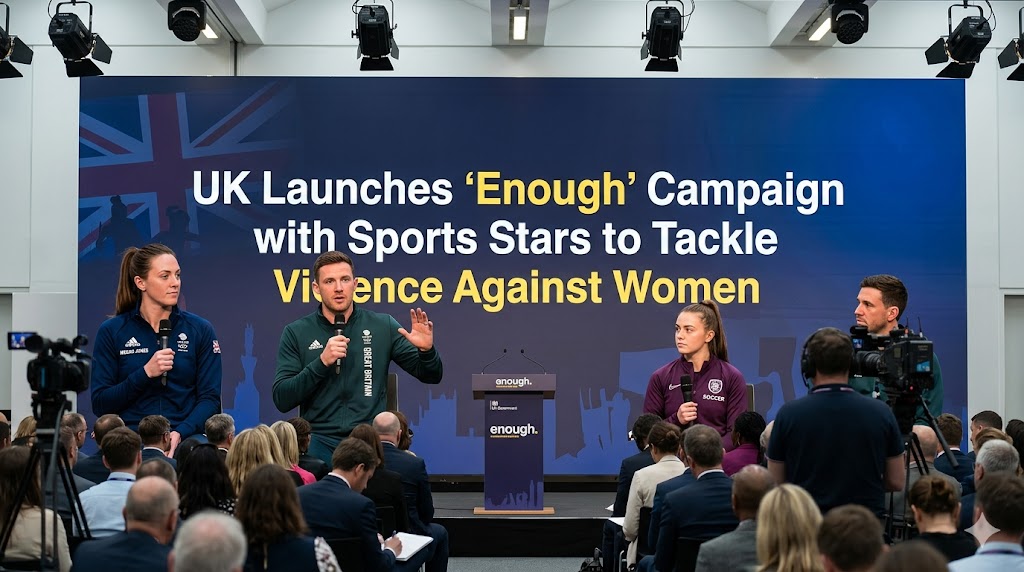
Some of the UK’s biggest sports stars are stepping into a different kind of arena, one that goes beyond football pitches and boxing rings to confront a growing national crisis.
Names like Chloe Kelly, Dan Burn and Conor Benn are now part of the government’s “Enough” campaign, a nationwide effort to challenge and reduce violence against women and girls.
At first glance, it may look like another awareness campaign. But the scale of the issue tells a deeper story.
Across England and Wales, millions of women have experienced domestic abuse, stalking, or sexual violence. In 2025 alone, hundreds of thousands of offences were recorded, highlighting a reality that many people, especially within diaspora communities recognise but don’t always openly discuss.
For Nigerians living in the UK, this conversation often sits at a complicated intersection of culture, silence, and survival.
There are things people grow up hearing:
“Keep your relationship private.”
“Don’t bring shame to the family.”
“Endure, it will get better.”
But campaigns like this are trying to shift that mindset.
The “Enough” campaign is not just about telling victims to speak up. It is focused on something more direct: helping people recognise what abusive behaviour actually looks like, especially the subtle forms that are often normalised or ignored.
Through a new social media content series developed with Sky Media and MG OMD, the campaign places athletes in everyday scenarios that show how certain behaviours cross the line, from controlling language to intimidation and emotional abuse.
The goal is simple but powerful: make people pause and think, “Is this okay?”
Because change often starts with recognition.
For many young men, especially those who look up to footballers and athletes, seeing familiar faces speak on these issues carries weight in a way traditional messaging sometimes doesn’t.
And the campaign is not limited to social media.
Major organisations like TSB and the Night Time Industries Association are helping bring the message into real-world spaces, banks, workplaces, nightlife venues where everyday interactions happen.
This matters because violence against women doesn’t exist in isolation. It happens in homes, on nights out, in relationships that look “normal” from the outside.
For diaspora communities, this is where the conversation becomes even more important.
Living abroad often means navigating two cultural systems at once. What may be tolerated or overlooked in one environment can be challenged more openly in another. That tension can be uncomfortable—but it can also be a space for growth.
The UK government has set an ambitious target: to halve violence against women and girls within a decade. Behind that goal is a broader strategy that includes stronger protections for victims, tougher monitoring of offenders, and more support services for those at risk.
But policies alone don’t change behaviour.
People do.
And that’s where campaigns like this are trying to make a difference—by speaking directly to individuals, not just institutions.
For Nigerians and other Africans in the UK, the message is not about abandoning culture. It’s about protecting people within it.
It’s about understanding that respect is not silence.
That love is not control.
That strength is not dominance.
It’s also about recognising that abuse doesn’t always start with something obvious. Sometimes it begins with words, patterns, or small actions that slowly escalate.
And if those early signs are ignored, the consequences can be life-changing.
That’s why awareness matters.
Because when more people can recognise harmful behaviour early, more people can step in, speak up, or walk away before things get worse.
The involvement of high-profile athletes adds visibility, but the real impact of this campaign will be measured in quieter moments in conversations at home, in choices made in relationships, in the courage to challenge what once felt normal.
For many in the diaspora, this is not just a UK issue.
It’s a human one.
And as the message of “Enough” spreads across screens, stadiums, and streets, it carries a simple but urgent reminder:
Change doesn’t start somewhere else.
It starts with what each person chooses to accept—and what they refuse to ignore.