
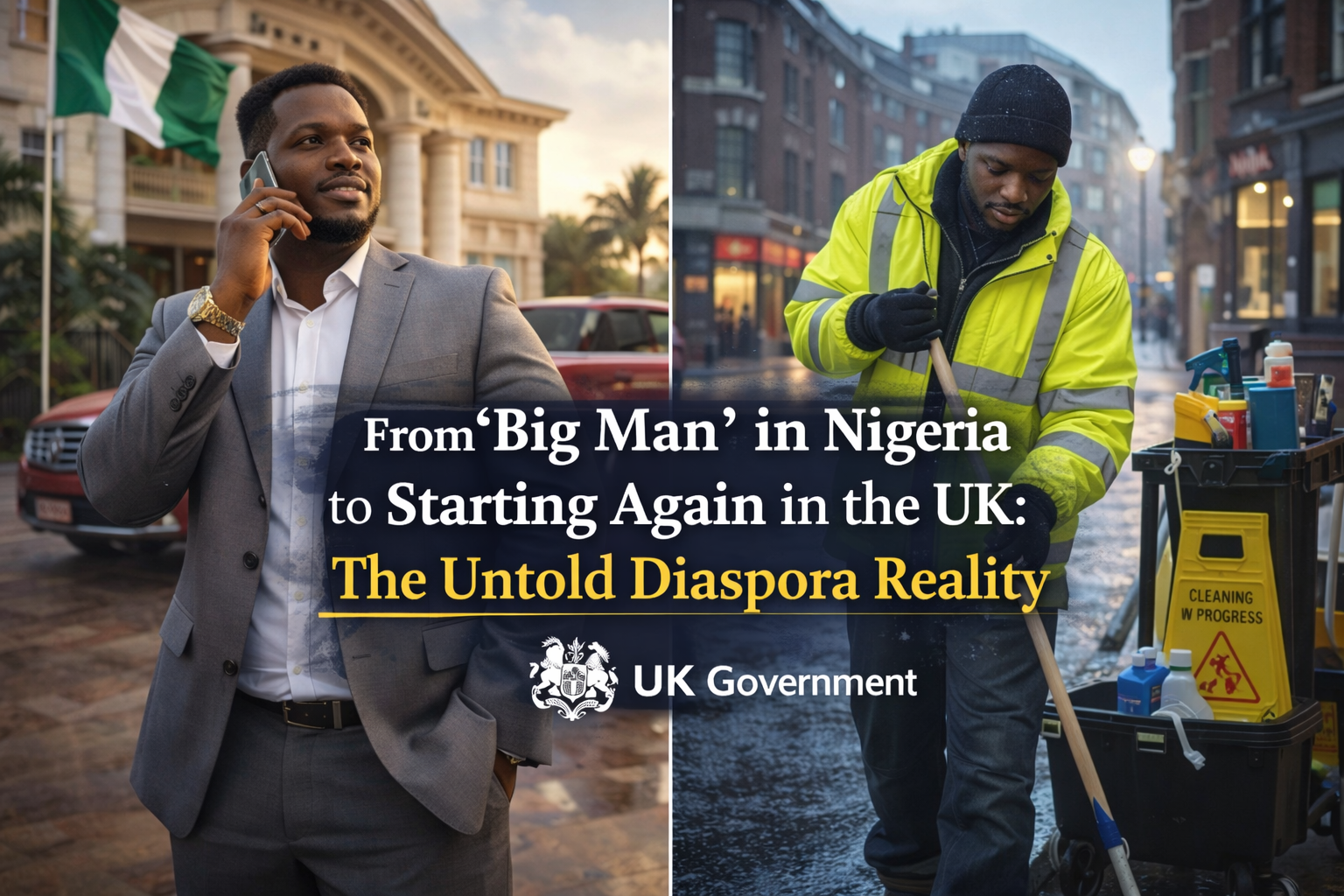
At Chijos News, we tell thereal stories of Nigerians in the UK not just the visa headlines and policy updates, but the emotional journeys behind the relocation. From identity shifts to financial resets, from pride to perseverance, we explore what it truly means to start again abroad. Because for many in the diaspora, migration is not just about geography, it is about rebuilding status, dignity, and self in a new land.
You know that moment.
Someone was respected in Nigeria. Comfortable. Connected. Known. Maybe not a billionaire, but established. A bank manager. A civil servant. A lecturer. A business owner. A doctor with their own clinic. People greeted them properly. Doors opened. Their name carried weight.
Then they moved to the UK.
No driver. No “Oga good afternoon sir.” No office with air conditioning and a PA bringing coffee. Just winter jackets, Google Maps, shift patterns, and a National Insurance number they’re still memorising.
This is the part of the japa story that social media rarely shows.
The Comfort of Being a “Big Man” Back Home
In Nigeria, status is layered. Being a “big man” does not always mean wealth beyond imagination. It can simply mean stability, recognition, and respect.
You had a rhythm. A network. A place in society.
Maybe you were the one approving leave. The one people waited for in meetings. The one others called when they needed help or influence. In church, in your industry, in your estate — you were known.
Then came the decision to leave.
Why Leave If Life Was Already Good?
People often ask this question with suspicion: If you were doing well in Nigeria, why did you still relocate to the UK?
The answer is rarely simple.
For many Nigerians in the diaspora, the decision was about children’s education, safety, healthcare, or long-term stability. It was about insecurity, economic uncertainty, inflation, stress, and the exhausting unpredictability of daily systems.
A senior banker in Lagos might have had comfort but also constant pressure. A doctor in Abuja may have run a thriving practice but grown tired of treating gunshot victims without adequate hospital resources. A contractor may have earned well but worried about what retirement would look like in an unstable system.
So yes, life may have been “good.” But it wasn’t always secure.
Landing in the UK: When Titles Don’t Travel
One of the biggest shocks for Nigerian immigrants in the UK is realising that titles do not pass through immigration control.
At Heathrow or Gatwick, nobody knows you. On the bus, nobody stands because you are “Chief.” Your degrees may be respected, but your experience may not immediately translate into equivalent roles.
A former senior manager might start in a call centre. A business owner might begin as a support worker. A director might find himself in a warehouse.
It is not always about ability. It is often about accreditation, local experience, and starting again within a new system.
And that can bruise the ego.
The Ego Adjustment: From Giving Instructions to Taking Them
Perhaps the hardest part is not the weather, the accent, or even the bills.
It is identity.
In Nigeria, you were the decision-maker. In the UK, you might be asking for shift approval. You might be told when you can take leave. You might be supervised by someone half your age.
That adjustment can feel humbling, sometimes painfully so.
But it also forces a deeper question: Who am I without my title?
The Financial Reset in the UK
Another quiet reality many Nigerians in the UK face is the financial recalibration.
Back home, your money might have stretched further. You could support extended family, employ staff, eat out comfortably, and still maintain certain luxuries.
In the UK, even with a decent salary, rent, council tax, energy bills, transport, insurance, and food quickly claim their share. The lifestyle changes. There is less spontaneous spending and more direct debits.
You may not be poor. But you may no longer feel like “big man.” You feel… responsible.
The Identity Crisis Many Don’t Admit
Read Also: The Myth of Soft Life Abroad: The Real Truth About Living in the UK
For many professionals who relocate from Nigeria to the UK, the biggest battle is internal.
Nobody calls you “sir” in that familiar Nigerian way. Your neighbours do not know your history. At work, you are simply “the new starter.” Your children adapt faster than you. They pick up British accents. They understand the school system. They even correct your pronunciation of “Leicester.”
It can be beautiful and humbling at the same time.
Sometimes there is quiet grief for the life you left behind the office, the staff, the recognition, the noise, the language, the sense of importance.
Missing home does not mean you regret leaving. It means you are human.
Marriage and Power Shifts in the Diaspora
Relocation can also shift family dynamics.
In Nigeria, one partner may have carried the financial weight. In the UK, the other partner might secure employment faster. A wife who adapts quickly may become the main earner for a period. A husband who once held senior status may need time to re-establish his career.
These shifts can create tension if pride takes centre stage. But they can also create growth if both partners understand that rebuilding takes time.
The Long Game: Rebuilding Status in a New Way
The story does not end at “starting again.”
Many Nigerians who begin at entry-level roles in the UK do not stay there. Over time, they convert qualifications, gain local experience, build networks, move into leadership roles, or start businesses again.
Care assistants become managers. Warehouse staff become supervisors. Teaching assistants become lecturers again. Small food businesses grow into thriving enterprises.
It is rarely instant. It requires patience, humility, and strategy. But it happens.
Starting again is not permanent, it is a phase.
Different Battles, Not a Downgrade
From the outside, some may say, “He was a big man in Nigeria. Now he is just an ordinary worker in the UK.”
But that is a shallow interpretation.
In Nigeria, you may have been battling unstable systems, corruption, insecurity, and economic unpredictability. In the UK, you may be battling loneliness, high living costs, immigration rules, and identity shifts.
The terrain changed. The fight changed.
But your courage remained.
You did not become less. You made a calculated trade — immediate status for long-term stability. Familiar recognition for safer systems. Comfort for opportunity.
And that is not weakness. It is strength.
For Anyone Quietly Starting Again
If you are in that rebuilding phase right now, feeling smaller than you once did, remember this:
Your worth is not your former title. Your value did not expire at Murtala Muhammed Airport. Your story did not peak in Nigeria.
You are not just a former “big man.”
You are a person adapting, evolving, and building again.
And for many Nigerians in the UK diaspora, that quiet resilience is the real definition of success.

