
There is a particular kind of shock many Nigerians experience the first time they seriously search for rent in the UK. You open a property listing, stare at the monthly figure, look at your salary again, and wonder how people are managing.
For many migrants, that moment becomes a turning point.
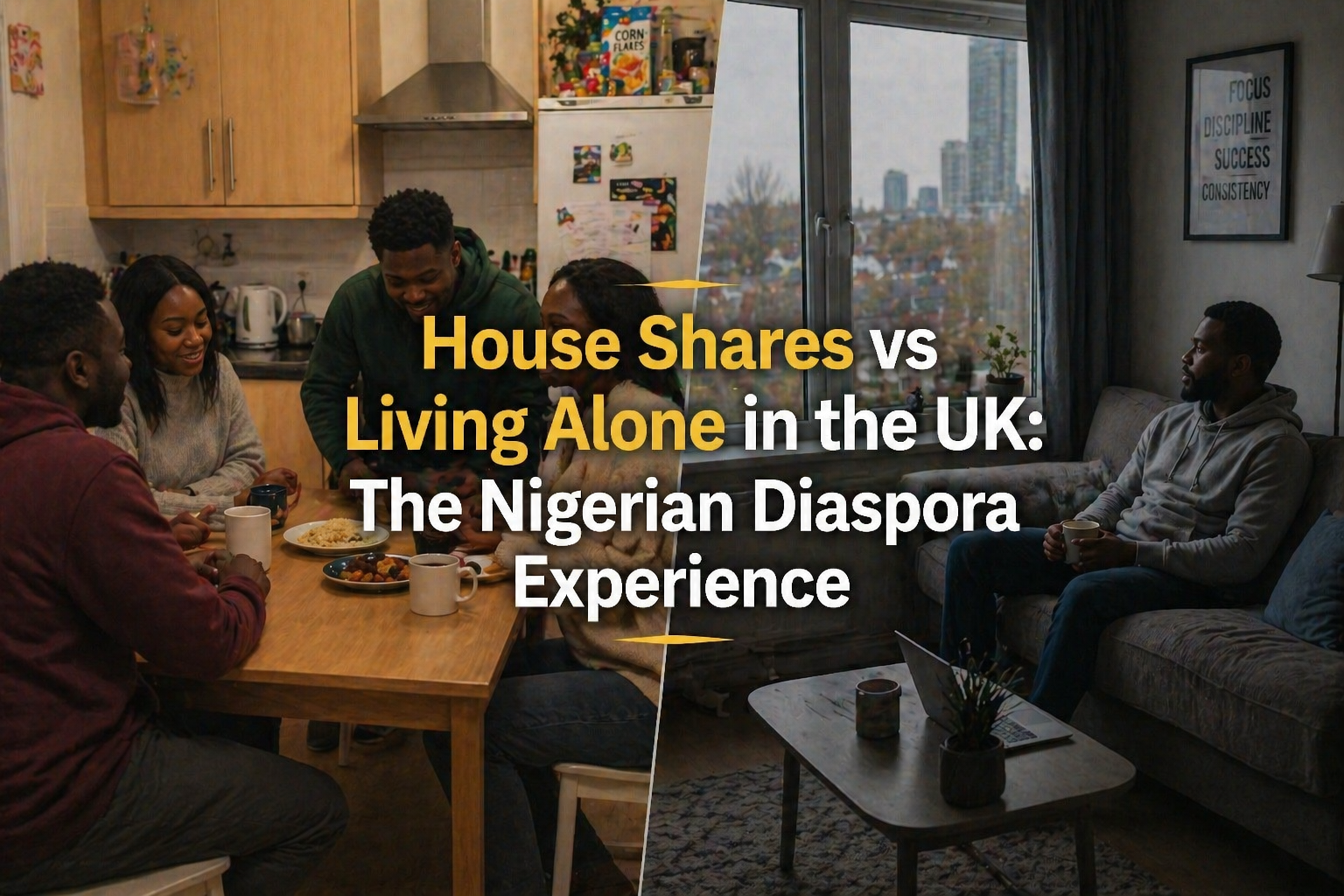
Do you move into a shared house and save money while sacrificing some privacy? Or do you push for your own place and pay heavily for peace?
On paper, it sounds like a housing decision. In reality, for many Nigerians in Britain, it touches money, dignity, mental health, loneliness, community, and even identity.
For many, the Nigerian UK experience begins with a house share, not because it was the dream, but because it was the most realistic way to start.
When UK Rent Gives You a Reality Check
Most Nigerians arrive with the general understanding that rent is expensive, but many do not fully understand what that means until they begin searching.
A single room can cost what might rent an entire apartment in parts of Lagos. Tiny studio flats can come with prices that make you question whether privacy is a luxury item.
That is often when shared accommodation stops looking like a compromise and starts looking like survival.
Chika arrived in Manchester as a student convinced she would rent a small place alone. After a week of browsing listings, she laughed in disbelief and asked a friend, “If I pay this rent, what exactly will I eat?”
That is how many people meet the house share life.
Not through preference, but through mathematics.
Why So Many Nigerians Start With House Shares
For many migrants, a house share is a first chapter.
It spreads financial pressure in a way that makes life possible. Rent, bills and council tax often become manageable because they are shared, and that breathing space can mean the difference between barely surviving and having enough left to save, study or support family back home.
Bisi, who worked in care when she first arrived, often says her shared accommodation helped her survive those early years. Because bills were included, she could still send money home and slowly build herself up.
There is also the practical reality that renting a room can be easier than securing an entire flat. Many landlords want references, credit records and income thresholds new migrants simply do not yet have.
Then there is something many people underestimate until they arrive: loneliness.
Starting life in a new country can be emotionally hard. Having other people around, even imperfectly, can soften that.
Tunde once joked his first winter in Britain might have “finished him” if not for his housemates dragging him into kitchen conversations when seasonal loneliness hit.
For many Nigerians, a house share is not simply cheap accommodation. It can be a landing pad.
The Good Side of House Shares Nobody Talks About Enough
Shared living can come with frustrations, but it can also bring forms of support people rarely mention.
Many migrants learn how Britain works through housemates.
Someone explains council tax.
Someone helps you register with a GP.
Someone teaches you how to top up utilities.
Someone shares where to find cheaper African food.
Those things matter.
Ada still laughs remembering how a housemate explained council tax after she spent weeks confused about the letters arriving through the door.
Then there is culture.
For Nigerians sharing with fellow Africans, hearing Afrobeats through a wall or smelling jollof from the kitchen can feel grounding in ways difficult to explain.
Those ordinary details can make a foreign country feel less foreign.
Financially too, shared living often creates breathing room for long-term goals.
Professional exams.
Savings.
Immigration costs.
Supporting relatives back home.
Ife says she could not have funded her professional qualifications if she had insisted on living alone in her early years.
For many, the house share is not glamorous.
But it helps build a future.
But House Shares Can Test Your Sanity
Of course, Nigerians know shared living can also come with premium stress.
Different people have wildly different ideas of cleanliness.
One person washes dishes instantly.
Another leaves pots soaking until they become emotional trauma.
Chinedu once came home from a night shift, saw old stew still sitting on the cooker and wondered how life had brought him there.
Then there is noise.
Door banging.
Phone calls at midnight.
Unexpected visitors.
Kitchen congestion.
Sometimes it feels communal.
Sometimes it feels chaotic.
Cultural misunderstandings can also sting.
Some Nigerians in mixed house shares speak about awkward comments about food smells, loud family calls or misunderstandings around communal habits.
These moments may seem small, but over time they shape how comfortable home feels.
Because that is the tension with house shares.
They can provide community.
They can also exhaust you.
Sometimes both at once.
Why Living Alone Feels Like a Major Milestone
After enough years of sharing kitchens and negotiating fridge space, many Nigerians start dreaming of one thing.
Their own place.
Their own bathroom.
Their own silence.
Their own peace.
For many, living alone feels symbolic.
It feels like progress.
Bola remembers moving into a studio and lying on the floor in complete silence simply because she could.
No doors slamming.
No sink drama.
No random kitchen politics.
Just peace.
That kind of quiet can feel luxurious.
Especially after years of shared living.
There is also something deeply affirming in paying for your own space.
It can feel like a personal marker that you are building stability in Britain.
Not just surviving it.
The Hidden Joy of Living Alone
Many Nigerians talk about living alone as emotional relief as much as housing.
You control the environment.
You decide how clean things are.
What food gets cooked.
Who visits.
When there is noise.
When there is none.
No labelled food in shared fridges.
No passive-aggressive kitchen notes.
No bathroom rota politics.
Ibrahim jokes the greatest joy of living alone was knowing no one could touch his stew again.
But beyond humour, many describe real mental peace.
For people working exhausting jobs, home becomes recovery.
A nurse once put it simply: after twelve hours on a ward, she could not come home and argue over dishes.
Living alone protected her sanity.
That peace matters.
But Privacy Comes at a Price
Living alone can also be financially brutal.
Full rent.
Full bills.
Full council tax.
No splitting anything.
Then winter arrives and heating bills introduce themselves.
Tomi says she briefly reconsidered her independence when her first winter energy bill landed.
And beyond cost, there is solitude.
Silence can feel peaceful.
It can also feel heavy.
Some migrants discover that coming home to nobody after long workdays can be emotionally hard, especially in darker winter months.
One Nigerian man admitted that while he loved his flat, he had to learn how to enjoy his own company because loneliness sometimes crept in unexpectedly.
Living alone can be freedom.
It can also demand emotional resilience.
For Many Nigerians, Housing Choices Shift With Life Stages
Often this is not a permanent identity but a season.
Many start in crowded shared housing.
Then move into quieter smaller shares.
Then perhaps a studio.
Then maybe a family home later.
It evolves.
Ife describes her journey almost like migration stages.
Five people in one house.
Then a calmer house share.
Then eventually her own studio.
Each move reflected a different stage of life.
And that is often how it works.
Your housing changes as your finances, priorities and emotional needs change.
There Is Also a Nigerian Pride Layer to This Conversation
This part rarely gets said openly.
But it exists.
Some Nigerians struggle emotionally with house shares because it can feel like a step backwards from the life they had at home.
Some had private apartments in Nigeria.
Then find themselves sharing bathrooms in Britain.
That adjustment can hit pride.
One man said he had to keep reminding himself shared living was a season, not a definition of failure.
That perspective matters.
Because comparison can make ordinary survival feel like shame.
And it should not.
The Truth Is, There Is No Superior Option
Some people flourish in shared living.
Some need their own space to stay mentally well.
Some find a middle ground, sharing with one friend instead of living in a large house share.
There is no universal right answer.
There is only what fits your season.
The better question is not whether living alone is more successful than sharing.
It is what arrangement gives you the best balance of affordability, peace, safety and growth right now.
That answer looks different at twenty-four than it does at thirty-four.
Different for a student.
Different for a parent.
Different for a new migrant trying to find their feet.
And that is okay.
House shares versus living alone is never really just about housing.
For Nigerians in the UK, it often becomes a conversation about rebuilding life from scratch, managing dignity in expensive cities, and figuring out how to create comfort in a place that can sometimes feel cold in more ways than one.
Some people find friendship and financial stability in house shares.
Others find healing and peace in living alone.
Both are valid.
Both are deeply human.
And for many Nigerians, the journey includes both.
You may begin by sharing a kitchen with strangers and one day hold keys to a place that is entirely yours.
Neither stage cancels the other.
Both can be part of building a life.
At Chijos News, we tell the real stories behind migration, not just policy headlines and visa updates, but the everyday realities Nigerians in the diaspora live through. From housing struggles and money pressures to identity, belonging and building a life abroad, these are the stories shaping our community. For Nigerians in the UK and across the diaspora, Chijos News remains committed to telling those stories with honesty, context and heart.