
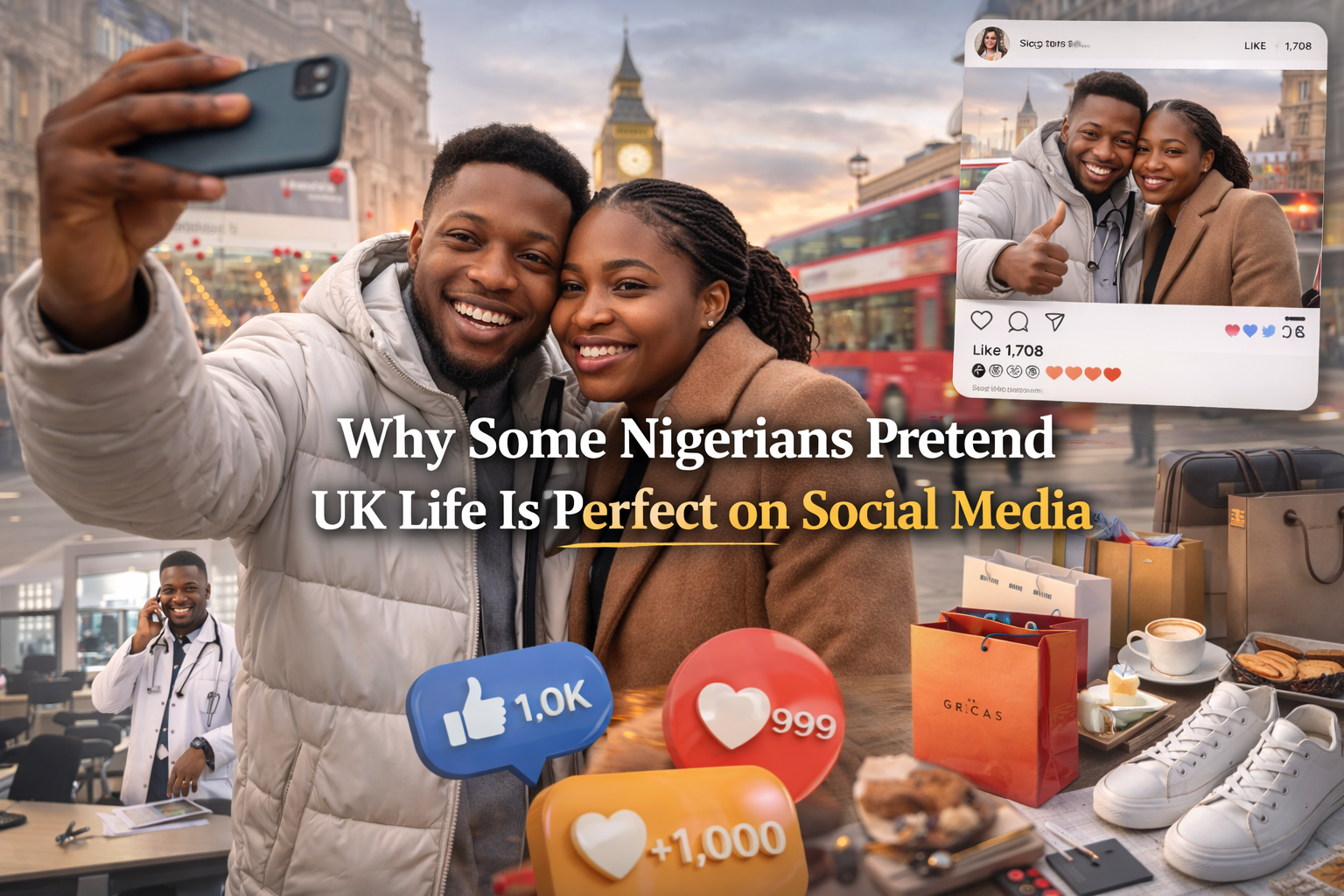
At Chijos News, we tell the stories behind the timelines. For Nigerians and the wider African diaspora in the UK, migration is more than a trend, it’s sacrifice, strategy, survival and sometimes silent pressure. Social media shows the highlights. We focus on the human reality. Because abroad is not just vibes and aesthetics; it’s bills, expectations, loneliness, gratitude and growth all mixed together. This is the conversation many people are having privately but rarely say out loud.
You know that thing where someone moves to the UK and suddenly their Instagram turns into a lifestyle magazine?
Every picture is vibes.
Every caption is gratitude.
Every story is “God did it”, “soft life only”, “outside again”.
Meanwhile, in real life, they’re on a night shift eating cold pasta in the staff room, calculating how to stretch their last £40 until payday.
Let’s talk honestly about why some Nigerians pretend UK life is perfect on social media. Not to drag anyone. Not to shame anyone. But to understand the pressure, the psychology and the quiet emotional cost behind the curated posts.
Most of the time, it’s not wickedness. It’s survival.
The performance starts before they even land in the UK
The performance of “soft life abroad” often begins long before Heathrow airport.
From the moment a UK visa is approved, the narrative starts building. The visa screenshot is posted with sensitive details covered. The “I’m leaving this country” tweets begin. The airport photos follow. Tears. Hugs. Suitcases. “New chapter.” “Abroad loading.” “Next level.”
By the time the plane lands in London, Manchester or Birmingham, a public storyline already exists. The person has “made it.” They have “escaped.” They have “upgraded.”
Tunde got his UK student visa after two refusals. His parents sold land and borrowed money to pay his tuition deposit. When he posted his airport picture, the comments were full of congratulations and predictions of soft life. Later he admitted, “From that moment, I felt like I wasn’t allowed to complain again.”
When expectations are built publicly, pressure grows privately.
The pressure of being the one who made it abroad
In many Nigerian families, the person who moves to the UK becomes more than an individual. They become hope. They become proof that the family can produce someone “overseas.” They become the investment everyone is watching.
Once you arrive, you are no longer just building your own life. You are carrying parents who sacrificed. Siblings waiting for school fees. Relatives expecting small support. Friends who now use you as motivation.
Amaka moved to the UK on a Skilled Worker visa. Within months, she started receiving subtle reminders from home. “Don’t forget us.” “Even if it’s small.” “You’re in pounds now.” She later said, “How can I now go online and say I’m struggling? It would look like I wasted everyone’s effort.”
So the Instagram stays positive. The captions stay grateful. The image stays intact.
Social media rewards aesthetics, not honesty
Platforms like Instagram and TikTok are not designed for emotional complexity. They reward aesthetic moments. They reward visible wins. They reward celebration.
If someone posts about loneliness in the UK, financial stress or immigration anxiety, the responses are often dismissive. “Come back then.” “Na you rush go.” “Others are there thriving.”
But if they post brunch photos, winter outfits and captions about growth, the likes flood in. The comments are supportive. The narrative remains powerful.
Chidera in Leeds once posted honestly about feeling overwhelmed. The response she received made her retreat back into curated content. “After that, I just posted food and outfits,” she said. “It was easier.”
Honesty can be expensive online. Aesthetic optimism is safer.
The fear of being seen as a failure
Migration to the UK is often loud. Send-off parties. Bold announcements. Public declarations of “I’m done with this country.” Once that kind of exit is performed publicly, it becomes psychologically harder to admit that life abroad is not as smooth as expected.
Many people discover that UK life includes heavy rent, council tax, transport costs, long work hours, visa stress and emotional isolation. But admitting that openly can feel like humiliation.
A man in London once said, “Sometimes I think about going back to Nigeria, but I remember all the noise I made when I was leaving. How will I explain it?”
So instead of full honesty, people curate. They show the one good restaurant visit, not the week of basic meals. They show the one weekend trip, not the overtime shifts that paid for it. They show progress, not pressure.
It is not complete deception. It is selective storytelling.
The double life: online soft, offline survival
Many Nigerians in the UK live two parallel realities.
Online, there is soft life. There are filters, captions about gratitude and carefully chosen highlights.
Offline, there are night shifts, overdrafts, visa deadlines and homesickness.
Ngozi in Birmingham once posted a smiling photo from a London day trip. That same week, she was negotiating her bank balance and worrying about bills. The picture was real. The stress was also real.
The internet rarely sees the full context. It sees the highlight reel.
Read Also: The Myth of Soft Life Abroad: The Real Truth About Living in the UK
Cultural pride and representation
There is also cultural pride involved. Nigerians, in particular, value presentation. There is an unspoken rule about representing well, especially abroad. Looking scattered or publicly distressed can feel like dishonouring the journey.
Some parents even advise their children to “package well” regardless of circumstances. That mindset naturally extends to social media.
The result is a polished version of UK life that prioritises dignity over vulnerability.
The comparison trap among Nigerians in the UK
Comparison does not only happen from Nigeria to the UK. It also happens within the diaspora.
One person posts a new car. Another posts a house deposit. Someone else announces a promotion. Suddenly, everyone else feels behind.
A student in Sheffield said she felt like she was failing after seeing constant posts of visible success. Later she discovered some of those same people were in serious debt or quietly struggling.
When everyone shows only success, struggle begins to feel like personal failure rather than shared reality.
The emotional cost of pretending everything is perfect
Maintaining a perfect image has consequences. It can make it harder to ask for help. It can increase isolation. It can create internal disconnection between who you are and who you appear to be.
One man in Coventry described feeling trapped inside his own success story. He had become “the one who made it abroad.” Admitting he was depressed felt impossible.
When perfection becomes a brand, vulnerability becomes risky.
But gratitude is also real
It is important to say that not all positive posts are fake. Many Nigerians in the UK are genuinely grateful for stability, healthcare, safety and opportunity.
A mother in Leeds spoke about her child’s improved access to medical support. She acknowledged the stress of bills and work, but her gratitude for better healthcare was sincere.
The problem is not joy. The problem is assuming joy means absence of struggle.
Why this conversation matters
For those in Nigeria watching from afar, the illusion of constant soft life can distort expectations. It can create urgency, shame or unrealistic assumptions about migration.
For those already in the UK, the myth of perfection can create silence and loneliness. It can stop people from speaking honestly about financial stress, immigration anxiety or emotional health.
More balanced conversations do not discourage migration. They encourage preparation.
Final reflection from Chijos News
At Chijos News, we believe diaspora stories deserve nuance. UK life is not automatically suffering. It is not automatically soft. It is complex.
Behind every “God did it” post, there is a human being managing rent, relationships, responsibility and reality. Some are thriving. Some are surviving. Most are somewhere in between.
If you are in the UK and curating your highlights, you are not evil. You are human. But you also deserve spaces where you do not have to perform.
And if you are watching from home, remember this: social media shows moments, not the full movie.
Soft life looks good on the timeline.
Real life, especially in the diaspora, is layered, demanding and deeply human.
Both can exist. But only honesty keeps us grounded.

