
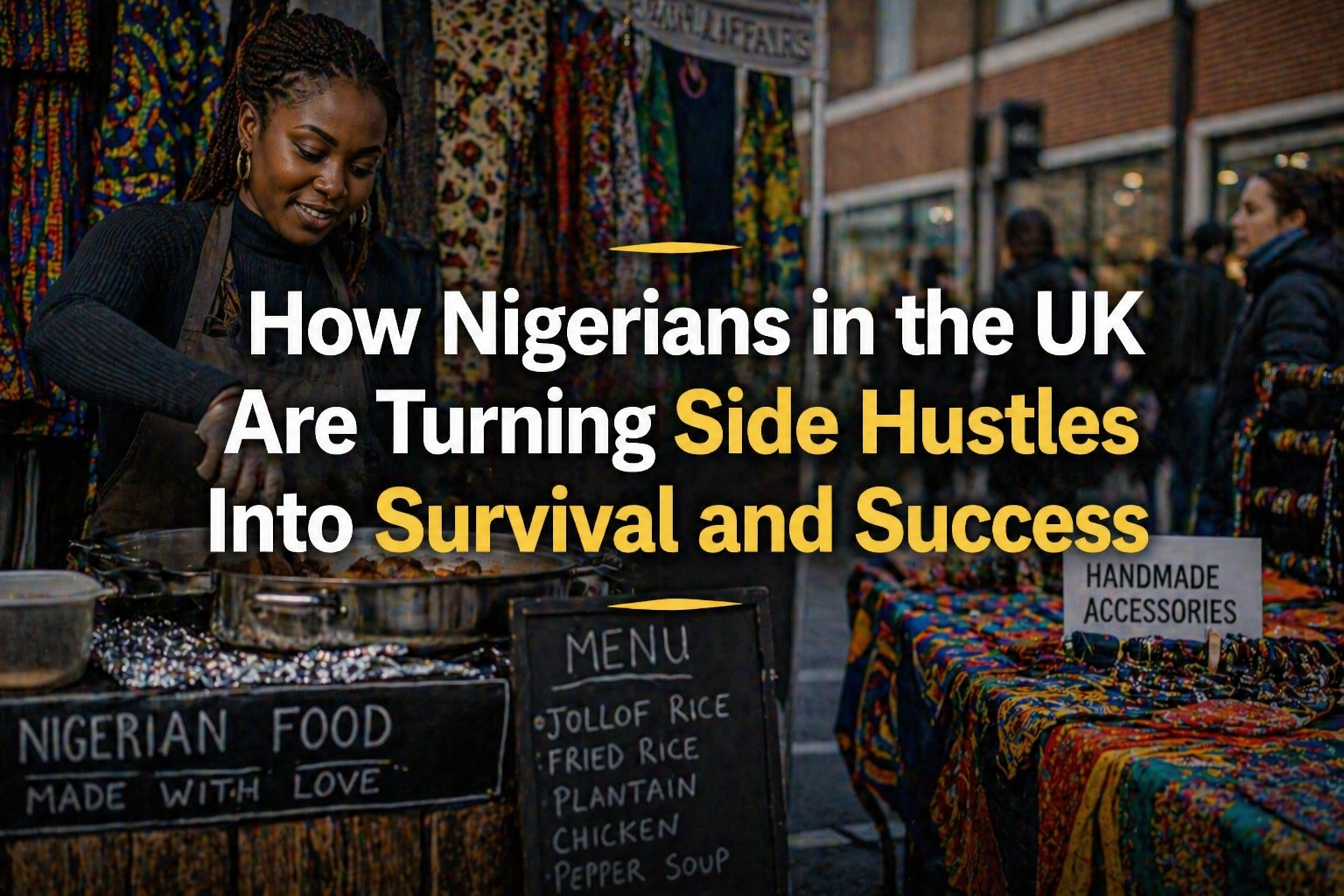
There is a phrase many Nigerians say with pride, humour and just a little stress in their voice: “I get 9 to 5, then I get side hustle.” It often sounds like a joke, but behind it sits a serious truth about migration, money, identity and survival.
For many Nigerians in Britain, side hustles are not just about making extra cash. They are about dignity in a system that can sometimes make migrants feel small. They are about control in a life often shaped by employers, visas, bills and obligations. They are about keeping creativity alive, preserving identity and refusing to let one payslip define your whole existence.
Across London, Manchester, Birmingham and beyond, Nigerians are building second incomes through food businesses, beauty services, delivery work, tutoring, digital content and countless other ventures. Some are doing it to survive rising costs. Some are doing it to support family back home. Some are doing it because hustling has always been part of who they are.
And for many, it is all three at once.
Side Hustle Culture Did Not Start in the UK
Long before relocation, many Nigerians were already living the side hustle life.
Back home, it was normal to meet bankers selling fashion on Instagram, teachers running private lessons after school, civil servants farming on the side, or students flipping products for profit. Multiple income streams were often less ambition than necessity.
So when Nigerians arrive in Britain and hear the idea that one stable job should be enough, many quietly reject it.
Because the Nigerian mind often thinks differently.
One salary may pay bills.
Two incomes may build a future.
That mindset does not disappear at Heathrow.
It relocates.
Chika understood this well. In Lagos, she worked in an office by day and sold wigs online at night. After moving to the UK and taking a retail job, her first instinct was not how to settle into one job, but how to restart her wig business in a new country.
That is not trend chasing.
That is instinct.
Why Life in Britain Pushes Many Nigerians Toward Side Hustles
Then reality in Britain adds fuel.
There is rent that can swallow half a salary. There is council tax, transport, childcare, rising food costs and the ever present weight of immigration fees.
Then there are the messages from home.
School fees.
Medical bills.
Family emergencies.
Requests that often begin with, “You are abroad now…”
Even people in decent jobs can feel stretched.
For those earning closer to minimum wage, the pressure can be sharper.
That is where side hustles start to feel less optional and more like breathing room.
Ibrahim works in a warehouse full time. His salary covers rent and essentials, but little else. So in the evenings he delivers food.
He once said the extra money does not make him rich, but it stops him feeling like he is drowning.
That feeling matters.
Because side hustles often create not just income, but psychological relief.
For Many Nigerians, Side Hustles Mean Control
There is also something deeper happening.
Migration can sometimes make people feel controlled.
Controlled by visa conditions.
Controlled by employers.
Controlled by systems.
A side hustle can feel like reclaiming something.
Something personal.
Something independent.
Something nobody can take away with one bad manager or one rota change.
Bisi, who works in care, says her agency controls enough of her life already. But when she is in her kitchen making puff puff and catering for weekend events, she feels like herself again.
Not just staff.
Not just a migrant worker.
Herself.
And that emotional meaning is why side hustles often become bigger than business.
They become identity.
Why Nigerian Side Hustles in the UK Are Booming
Food remains one of the strongest examples.
There is constant demand for jollof, suya, small chops and home style Nigerian meals. For many migrants, buying Nigerian food is not just eating.
It is memory.
It is comfort.
It is home.
Amaka works an office job during the week, then spends weekends cooking trays of party food for clients. She jokes that her kitchen becomes a restaurant every Friday night.
It is exhausting.
But she says it makes her feel alive.
Beauty and grooming have also become major spaces for Nigerian entrepreneurship.
Hair braiding, wig installation, barbering, makeup, nails.
Many Nigerians arrived with those skills already.
Britain simply gave them a different market.
Tomi works in a call centre but braids clients’ hair evenings and weekends. Her main job covers bills, she says. Hair pays for enjoyment and savings.
That distinction says a lot.
One income sustains.
The other expands.
Then there is the rise of digital hustles.
Content creation.
Freelancing.
Consulting.
Social media platforms.
What starts as sharing migration stories or cultural humour can become real income.
For some, storytelling itself has become business.
And for others, Uber, delivery apps and logistics offer flexible ways to turn time into extra money.
There is a reason so many Nigerians have embraced these models.
They reward effort.
And Nigerians have never been afraid of effort.
But There Is a Heavy Side Too
The inspiring version of hustle often hides the fatigue.
Because many people are working one full time job, running a business after hours, raising children, studying and supporting family all at once.
That is not ambition alone.
That is strain.
A Nigerian woman once described working care shifts, doing hair weekends and studying for exams, then waking up some mornings with her body simply protesting.
Yet still carrying on.
Because responsibilities do not pause.
That is the hidden side of side hustle culture people do not post enough about.
Burnout.
Exhaustion.
The question many quietly carry:
How long can I keep doing this?
And it is a fair question.
Because hustle without boundaries can become another form of survival pressure.
Read Also: Why Nigerians Work in Care, Tech and Security in the UK Explained
Sometimes the Side Hustle Feels More Like the Real You
For many migrants, there is another emotional layer.
Their main job may not reflect who they were.
Or who they still believe they are.
A former media professional working warehouse shifts may feel more like himself on his podcast than on the job.
A teacher awaiting UK recognition may feel most alive while tutoring.
A former entrepreneur may feel restored while growing a small business after work.
Sometimes the side hustle is not “extra”.
It is where identity survived relocation.
One Nigerian man now working in a warehouse still hosts events and runs a podcast on the side.
He once said the warehouse pays survival.
The microphone feeds his soul.
That sentence explains a lot.
Community Fuels Nigerian Hustle Culture
Another reason Nigerian side hustles thrive is community.
Diaspora networks often become first markets.
Church groups.
WhatsApp groups.
Friends referring friends.
Support often spreads through relationships long before formal marketing.
That is how many businesses begin.
Someone cooks for one birthday.
Braids one friend.
Does one delivery.
And word spreads.
That informal ecosystem is powerful.
Though it also comes with familiar Nigerian challenges.
Friends wanting discounts.
Family expecting freebies.
Support mixed with pressure.
Still, community remains one of the strongest engines behind diaspora entrepreneurship.
When Side Hustles Become Main Businesses
Sometimes the side hustle grows beyond “side”.
A bedroom nail business becomes a studio.
Weekend catering becomes a registered food company.
Uber driving evolves into a logistics business.
A content page becomes a media brand.
Bola started doing nails from her room while working retail.
Eventually her clients outgrew her spare time.
She opened a studio and left her job.
Stories like that fuel a lot of Nigerian hustle dreams.
Not because everyone wants to quit their main job.
But because possibility matters.
What Nigerian Side Hustle Culture Really Reveals
If you strip away the jokes and motivational captions, something deeper shows.
This culture reflects resilience.
Creativity.
Responsibility.
And often, grief.
Because behind many side hustles are people rebuilding after professional downgrades, migration shocks and identity loss.
Sometimes a side hustle is also a quiet way of saying:
I am still more than what this system currently sees.
And that is powerful.
Because it is not just economic.
It is emotional.
It is cultural.
It is personal.
Side Hustle Is More Than Hustle, It Is Diaspora Storytelling
When a Nigerian says they do care work and bake on weekends, or work in IT and drive Uber sometimes, or work retail and braid hair at home, they are not just describing extra income.
They are describing migration in motion.
Dreams adjusting.
Pressure being managed.
Identity refusing to die.
For many Nigerians in the UK, side hustle culture is not simply about making money.
It is about making space.
Space for ambition.
Space for survival.
Space for dignity.
And maybe that is why it resonates so deeply.
Because behind every extra shift, every food order, every braid appointment, every delivery ride and every online business is someone quietly rewriting their story.
One hustle at a time.
At Chijos News, we keep telling these diaspora stories because they are about far more than money. They are about how Nigerians abroad build, adapt and create new futures even when the odds are heavy. From London side hustles to long term legacy, the Nigerian diaspora story is still being written, and often, it starts after the 9 to 5 ends.