
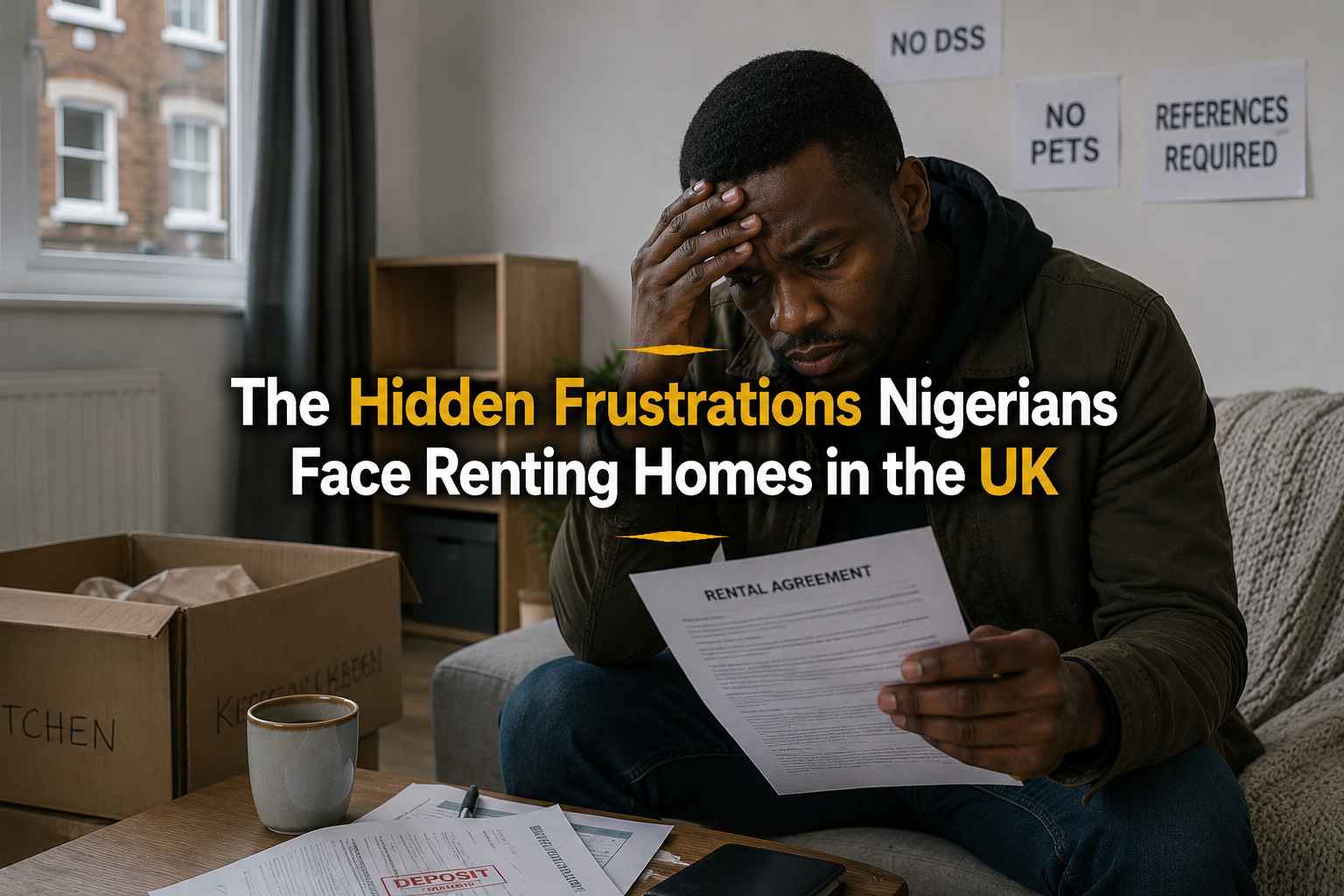
Renting in the UK can humble you in ways you never expected. You can arrive with degrees, savings, a good job offer and genuine hope for a fresh start, only to discover that finding somewhere to live feels like a full-time emotional battle. For many Nigerians, the housing struggle abroad is not just about rent prices or paperwork. It is about identity, dignity, loneliness and constantly feeling like you must prove yourself before anyone trusts you with a set of keys.
People often talk about relocating abroad as though it is one smooth success story filled with airport photos, winter jackets and career breakthroughs. What gets left out are the exhausting evenings spent scrolling endlessly through rental listings, the unanswered emails from letting agents, the awkward house viewings and the uncomfortable feeling of being assessed before you even open your mouth properly. For many Nigerians in the UK, renting becomes one of the first moments where the excitement of “japa” collides hard with reality.
One of the biggest shocks for many newcomers is discovering that having money is not always enough. Back home in Nigeria, if you can afford the rent and pay upfront, most landlords are willing to move forward quickly. In the UK, the process feels completely different. Suddenly your salary is only one part of the equation. Agents want payslips, credit scores, references, employment contracts and sometimes a guarantor who already lives in the UK. For someone who has just arrived, those things simply do not exist yet.
A Nigerian woman named Chika thought she had prepared properly before moving to Manchester. She had secured a decent job and saved enough money to cover several months of expenses. Yet every flat application seemed to hit the same wall. Agents kept asking for proof of long-term UK employment history and references from previous landlords in Britain. She had neither. One landlord eventually rejected her application despite her financial readiness. She later admitted the experience made her feel unwanted before she had even settled into the country.
That feeling of starting from zero emotionally affects many Nigerians abroad. You realise quickly that relocation is not just about earning pounds instead of naira. It is about rebuilding trust and credibility from scratch in a system that rewards familiarity and history. You may be accomplished back home, but in the UK housing market, you are often treated like someone with no track record at all.
The guarantor issue creates another layer of stress. Many Nigerians hear the question, “Do you have a UK-based guarantor?” and immediately feel anxiety. A guarantor is expected to cover your rent if you cannot pay, and usually must meet strict financial requirements. For people who are the first in their family to relocate, finding someone willing and qualified to take on that responsibility is incredibly difficult.
Ibrahim experienced this after graduating from university in the UK and securing a job. He found a one-bedroom apartment he liked, only to be told he needed either a guarantor or six months of rent upfront. He did not have relatives established enough in Britain to help him, and the upfront payment requirement nearly emptied his savings. What frustrated him most was not just the cost, but the feeling that he was constantly having to convince people he deserved basic stability.
For many Nigerians, there is also the quiet issue of discrimination that rarely gets spoken about openly. It does not always appear in obvious ways. Sometimes it comes through delayed responses, cancelled viewings or polite rejection emails that leave you wondering what really happened. Many migrants quietly notice how conversations change once their accent or full Nigerian name becomes clear.
Ada once enquired about a flat and was initially told it was available. After she sent her details, communication suddenly stopped. Later, a colleague contacted the same agent and secured a viewing almost immediately. Ada could not prove discrimination, but the pattern left her deeply uncomfortable. Another Nigerian renter admitted she began shortening her name on applications because she noticed agents responded faster when they could not immediately identify her background.
Experiences like these can slowly chip away at your confidence. You begin to overanalyse every interaction and wonder whether rejection is about paperwork, immigration status, race or simply bad luck. The uncertainty itself becomes emotionally draining.
Then there is the reality of house sharing, which many Nigerians reluctantly accept because renting alone is expensive. In theory, a house share sounds manageable. In practice, it can become emotionally exhausting. Adults who once lived independently in Nigeria suddenly find themselves negotiating over fridge shelves, bathroom schedules and kitchen hygiene with strangers from different cultures and lifestyles.
Tunde moved into a shared house after arriving in the UK because it was the only affordable option. Although the rent was manageable, the experience made him feel as though he had lost a sense of adulthood and privacy. Some housemates complained about the smell of Nigerian food while others ignored cleaning responsibilities completely. He described the experience as mentally tiring because home no longer felt like a place to rest.
For many migrants, that adjustment is emotionally difficult because it often feels like a downgrade from the life they left behind. Someone who had their own apartment or comfortable family home in Lagos may suddenly find themselves sharing thin walls and limited space in Britain. It can create a strange emotional conflict where you know you are building a future, yet parts of your present feel smaller and harder than your past.
The UK rental system also demands an overwhelming amount of documentation. Nigerians quickly learn that renting often involves exposing large parts of your personal life to strangers. Bank statements, visa documents, work contracts and detailed financial histories become normal requests. For people supporting relatives back home or receiving transfers from family, ordinary financial activity can suddenly attract uncomfortable questions.
One Nigerian woman, Ife, was asked to explain multiple international transactions showing on her bank statements while applying for a flat. Those transfers were simply money sent to family members in Nigeria and occasional support from her husband abroad. Yet she found herself having to justify personal financial decisions to an agent she had never met before. The process made her feel exposed and judged.
Another hidden frustration comes from the cost of living beyond rent itself. Many Nigerians underestimate how expensive utilities and council tax can be. In Nigeria, housing costs are often simpler to understand. In the UK, rent is only the beginning. Electricity, gas, water, broadband and council tax quickly pile up, creating constant financial pressure.
Read Also: Why Many Nigerians in the UK Quietly Downplay Their Success Back Home
Chinedu rented a flat that initially seemed affordable, only to discover that council tax added a major extra monthly cost. By the time all the bills arrived, he realised he had seriously underestimated his expenses. Like many Nigerians abroad, he found himself cutting back on social life and personal spending just to stay afloat.
Area choices also create difficult decisions for migrants. Many Nigerians rely on advice from colleagues or online searches when choosing where to live, but recommendations are often influenced by class and racial perceptions. Some areas labelled “rough” simply have larger Black and immigrant populations, while other genuinely deprived areas become the only affordable options for newcomers.
Ada noticed this when colleagues warned her against living in a diverse neighbourhood filled with African and Asian families. Yet when she visited, she found local shops, churches and familiar cultural energy that actually made her feel more comfortable. She later realised that certain descriptions of areas were sometimes shaped more by prejudice than reality.
Landlords themselves can also become a major source of stress. Some are supportive and professional, but others take advantage of tenants who do not fully understand their rights. Nigerians who are new to the UK often avoid confrontation because they fear losing accommodation or being labelled difficult.
Bisi once lived in a house where the heating barely worked during winter. Despite repeated complaints, the landlord dismissed her concerns. She suffered through freezing nights because she worried that pushing harder might lead to eviction or tension. Stories like this are common among migrants who feel vulnerable within the rental system.
Perhaps the deepest emotional frustration is the feeling of moving backwards in living standards. Many Nigerians leave behind larger homes, familiar routines and support systems only to encounter cramped spaces and housing insecurity abroad. Even when the long-term opportunities are better, the short-term adjustment can feel emotionally painful.
Femi admitted there were moments he stood in a shared kitchen in Britain wondering how life had changed so dramatically. Back home, he had independence and comfort. In the UK, he was negotiating over sink space with strangers despite working hard every day. That grief is rarely discussed openly because many migrants feel pressure to appear grateful at all times.
There is also the constant fear of instability. For Nigerians on temporary visas, housing security often feels fragile. Losing a job, facing visa issues or experiencing relationship breakdowns can quickly threaten where you live. Many tenants never fully relax because they know their housing situation could change with little notice.
Yet despite all these frustrations, many Nigerians continue pushing forward and eventually create stability for themselves. The first successful tenancy application, the first private studio apartment or the first home that truly feels peaceful often carries enormous emotional meaning. These small milestones become proof that progress is happening, even if slowly.
One Nigerian woman described crying quietly after moving into her first solo apartment because it was the first time since relocating that she truly felt at peace. No noisy housemates, no awkward shared spaces, no fear of strangers entering the kitchen. Just silence, privacy and a feeling that she was finally beginning to settle into her new life.
Renting in the UK as a Nigerian is not simply about housing. It is about belonging, survival and rebuilding confidence in a place that can sometimes make you feel invisible. The frustrations are real, but so is the resilience many Nigerians show every day while navigating unfamiliar systems and trying to create stability abroad.
For those currently struggling with ignored applications, difficult landlords, overcrowded house shares or the emotional weight of starting over, your experience is more common than you think. It does not mean you failed. It means you are navigating one of the hardest parts of migration that people rarely post about online.
Over time, many Nigerians learn the system, build stronger financial histories and move into better housing situations. The journey can be exhausting, but every tenancy agreement signed, every room upgraded and every peaceful night in your own space becomes part of a larger story of persistence and rebuilding.
Chijos News continues to spotlight the real experiences of Nigerians and Africans in the diaspora, telling the untold stories behind migration, identity, survival and everyday life abroad with honesty, depth and cultural understanding.