
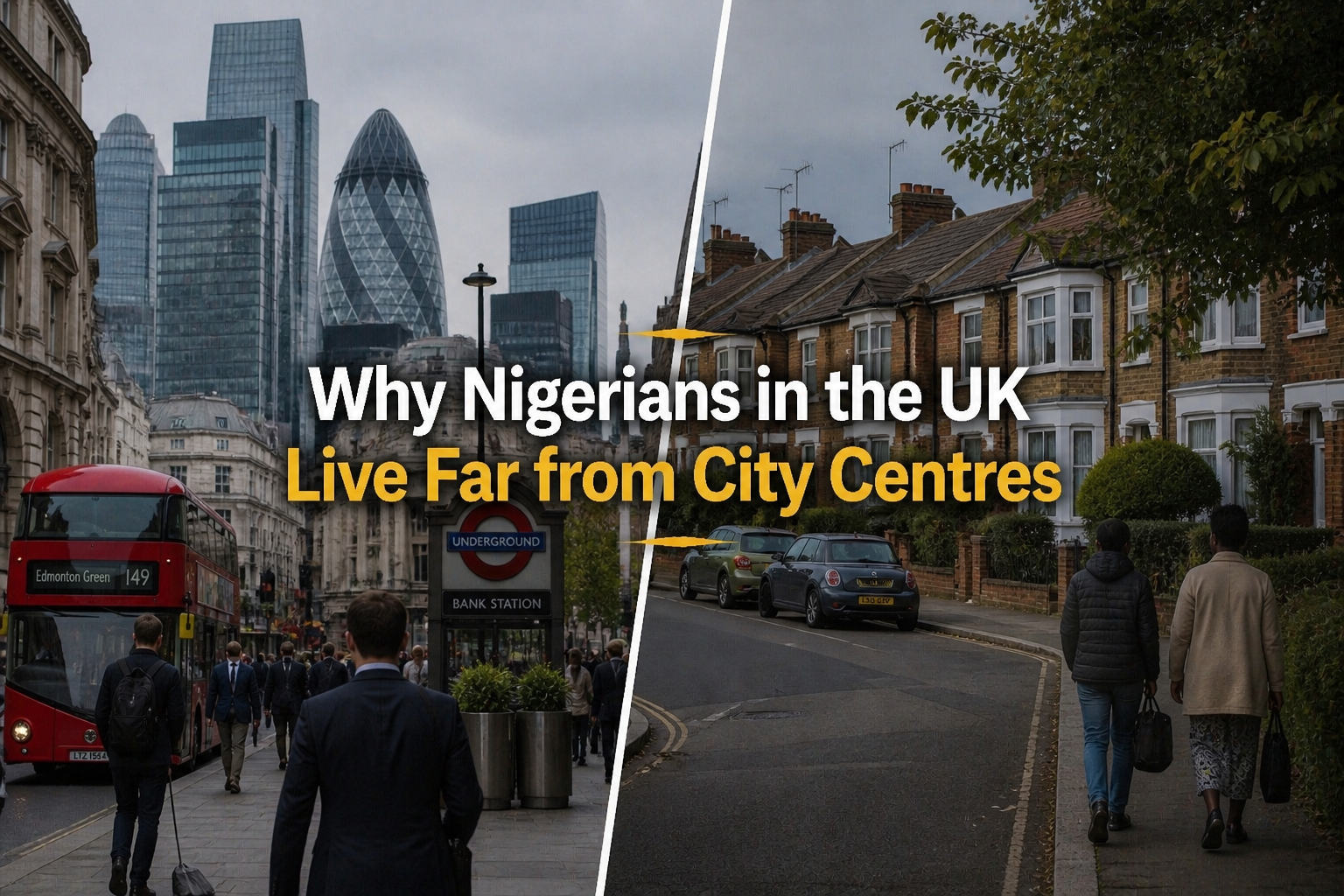
There is a familiar conversation you hear again and again across Nigerian communities in the UK. You ask someone where they live and they tell you they work in the city but stay one hour away. You check the map and realise it is not exaggeration. It is a daily reality shaped by far more than preference.
On the surface, it looks like a simple housing decision. In real life, it is a layered story that involves money, immigration status, family obligations, access to housing, and the quiet compromises people make just to stay afloat and build something stable.
For many Nigerians arriving in the UK, the first real shock comes when they see rent prices in city centres. What they imagined as convenient and lively quickly becomes financially unrealistic. One bedroom flats cost more than entire houses back home, and even studio apartments come with price tags that make you pause and rethink your entire plan. The idea of living close to work is attractive, but the numbers often do not agree.
That is where the shift begins. Not because people do not want to live centrally, but because the cost forces a different decision. Living further out offers more space and significantly lower rent, and for many, that difference is not optional. It is what allows them to survive.
For Nigerians, the financial calculation rarely stops at personal expenses. Many are supporting family members back home, paying school fees, contributing to household needs, or helping relatives stay afloat. When rent is taken from the same income that must stretch across two countries, every pound matters. Living further away from the city centre becomes a strategy, not just a compromise.
Immigration status also plays a role in shaping where people end up living. In the early stages of life in the UK, many Nigerians are navigating student visas, Skilled Worker visas, or new family arrangements. Income can be limited, credit history is often non existent, and options are restricted. The mindset in those early months or years is usually to manage what is affordable and stable, with the hope of upgrading later. What starts as a temporary arrangement often becomes long term as life settles and routines form.
Access to housing is not always straightforward either. Many Nigerians face quiet barriers when trying to rent in more central or competitive areas. Landlords and agents often prefer tenants with strong credit history, higher income levels, or long renting records in the UK. For someone newly arrived, even with a stable job, it can be difficult to meet those expectations. Rejections may not always be explained clearly, but they are felt. As a result, people look further out, where landlords may be more flexible and willing to take a chance.
House shares also shape this pattern. Many Nigerians begin their UK journey in shared accommodation, and these properties are more common outside city centres where larger houses can be converted into multiple rooms. Once someone settles into an area through a house share, they begin to build a life there. They learn the transport routes, find familiar shops, connect with community spaces, and gradually create a sense of belonging. Even when their circumstances improve, they may choose to stay and commute rather than start over somewhere new.
There is also a practical mindset that many Nigerians adopt. They would rather endure a longer commute than struggle under the pressure of high rent. The daily journey becomes part of the sacrifice, something that makes sense when it is tied to bigger goals like supporting family, saving money, or building something for the future. The commute is not always enjoyable, but it carries meaning.
Family life further pushes people away from city centres. Once children are involved, priorities shift. Space becomes more important than proximity. Parents begin to look for areas where their children can grow, attend school comfortably, and live in a quieter environment. City centre living can feel cramped and chaotic in comparison. Moving further out offers more room, both physically and emotionally.
Read Also: House Shares vs Living Alone in the UK: The Nigerian Reality of Rent, Privacy and Survival
Community also plays a powerful role in where Nigerians choose to live. Once a few people settle in an area, word spreads. Others follow, drawn by the presence of familiar faces, cultural spaces, and access to Nigerian food and services. Over time, these areas become small hubs of diaspora life. Living there may mean a longer commute, but it also brings a sense of belonging that city centres do not always offer.
There are also subtle social dynamics at play. Some Nigerians feel more comfortable in diverse or working class areas where they are less likely to stand out or feel scrutinised. In certain central or affluent locations, there can be an unspoken sense of not quite fitting in. Living further out can feel more relaxed and more accepting, even if it comes with trade offs.
Work patterns matter too. Many Nigerians are employed in sectors like healthcare, logistics, security, and retail, where workplaces are often located outside the traditional city centre. For shift workers especially, living closer to work is more important than living close to entertainment or business districts. A shorter commute at odd hours can make a significant difference to daily life.
Beyond all of this, there is the mental aspect. City centres are busy, loud and constantly active. For people already dealing with the pressures of migration, work, and responsibility, that environment can feel overwhelming. Living further out offers quiet, space and a chance to recharge. For some, that peace is worth more than convenience.
Of course, the commute itself comes with a cost. Long journeys take time and energy. They eat into rest, family life and personal time. Many Nigerians find themselves waking early and returning late, feeling as though a large part of their day is spent travelling. It is not easy, and it is not something people ignore. It is simply part of the balance they have chosen.
Over time, people adapt. They build routines around their commute, use the time to listen to music, catch up with family, or simply reflect. They begin to see the journey not just as distance, but as part of their wider story. For some, it remains temporary. For others, it becomes permanent as they build roots in the places they once saw as temporary stops.
When you look closely, living far from the city centre is not just about saving money. It is about navigating a system that was not built with your reality in mind and still finding a way to make it work. It is about stretching income across continents, building community in unfamiliar places, and making decisions that prioritise long term stability over short term comfort.
At Chijos News, we go beyond headlines to reflect the lived experiences of Nigerians in the UK and across the diaspora. Stories like this are not just about housing or commuting. They are about resilience, adaptation and the everyday decisions people make to build a life between two worlds. Wherever you are living, whether in the heart of the city or miles away from it, your journey is part of a wider story that deserves to be seen, understood and told properly.