
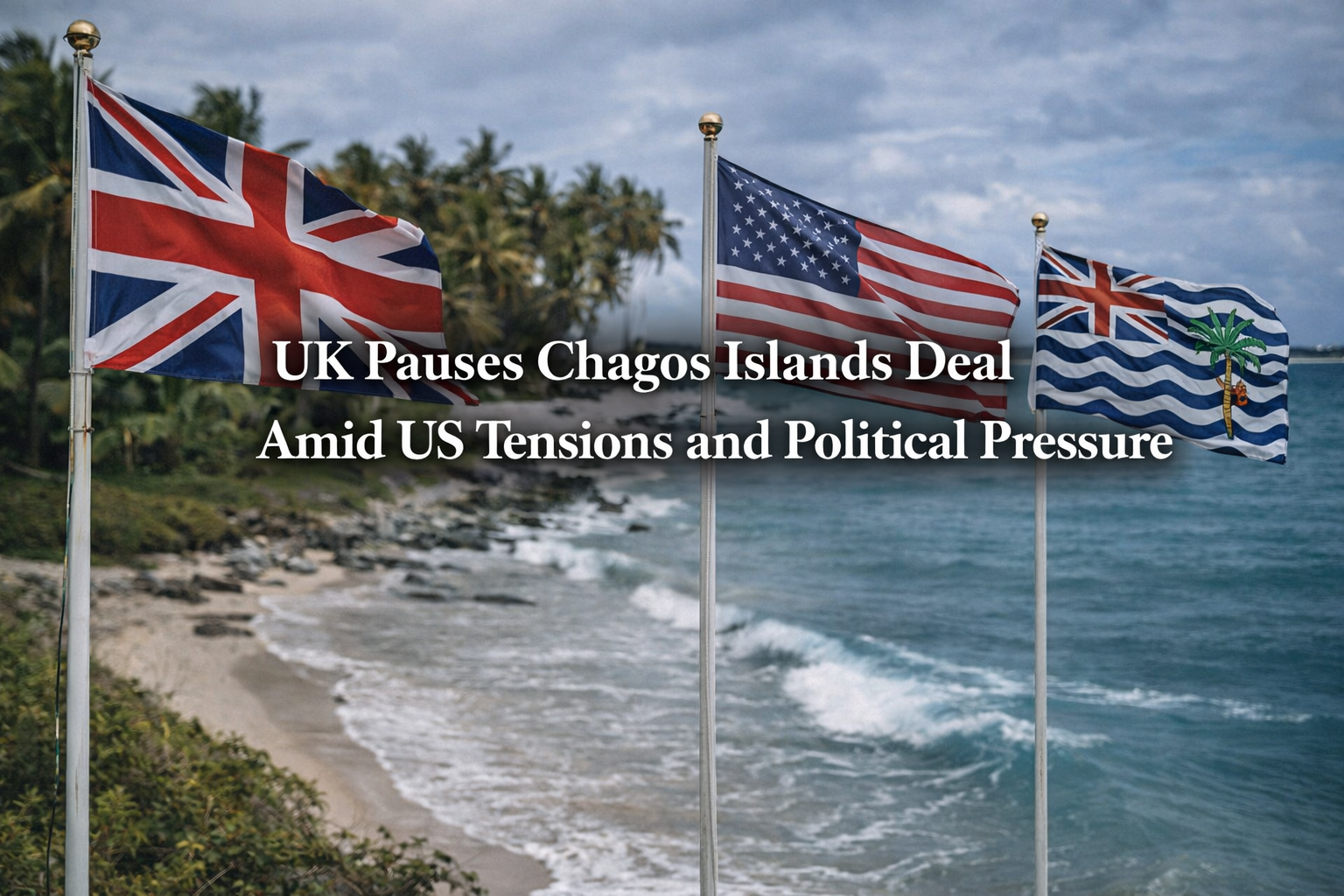
The UK government has paused a controversial deal to transfer sovereignty of the Chagos Islands, a move that reflects growing geopolitical tension and renewed scrutiny over one of Britain’s most sensitive overseas territories.
The proposed agreement would see the Chagos Islands handed over to Mauritius, while allowing the UK and the United States to retain control of the strategically vital military base on Diego Garcia under a long-term lease.
However, the deal has now been put on hold as the UK Government seeks formal backing from Washington, a key condition for the agreement to move forward.
According to reports, legislation needed to implement the deal will not be included in the government’s upcoming parliamentary agenda, signalling a clear delay while diplomatic discussions continue.
At the centre of the situation is the relationship between London and Washington. Keir Starmer’s government has indicated it will continue engaging with the United States in an effort to secure approval, emphasising that the long-term security of the Diego Garcia base remains a top priority.
The base itself plays a crucial role in global military operations, making it a sensitive point in negotiations. Under the proposed deal, Britain would lease the base for 99 years, ensuring continued joint UK and US presence.
But the agreement has faced criticism, particularly from Donald Trump, who previously described the deal as a “big mistake.” His remarks have added political weight to an already complex issue, especially given the importance of US support in finalising the arrangement.
Beyond geopolitics, there is a deeper human story that continues to shape the debate.
The Chagos Islands are not just a strategic location. They are home, or once were, to the Chagossian people. Between the late 1960s and 1970s, Britain forcibly displaced up to 2,000 indigenous residents to make way for the military base on Diego Garcia.
For many Chagossians and their descendants, the current negotiations reopen old wounds. Campaigners argue that discussions have largely focused on state interests, while the voices and rights of the displaced community have often been sidelined.
Advocates continue to call for justice, recognition and the possibility of dignified resettlement. They also question the broader legal and moral framework of decisions that excluded Chagossians from determining their own future.
At the same time, wider tensions between the UK and the US have added another layer of complexity. Differences in foreign policy positions in recent months have put strain on what is often described as the “special relationship” between the two countries. These dynamics may influence how quickly or smoothly the Chagos deal progresses.
For now, the UK government maintains that any agreement must protect both strategic interests and international partnerships. But the delay highlights just how delicate the balance is between diplomacy, defence and historical responsibility.
As discussions continue, the future of the Chagos Islands remains uncertain, shaped by global politics as much as by the unresolved legacy of its past.
At Chijos News, we recognise that stories like the Chagos Islands dispute resonate deeply within diaspora communities. They raise questions about displacement, identity, belonging and the long-term impact of political decisions on ordinary people. For Nigerians in the UK and across the world, these conversations echo familiar themes of migration, history and the search for stability in foreign lands. By bringing context and human perspective to global developments, Chijos News helps the diaspora stay informed about the issues that connect policy, people and place.

