
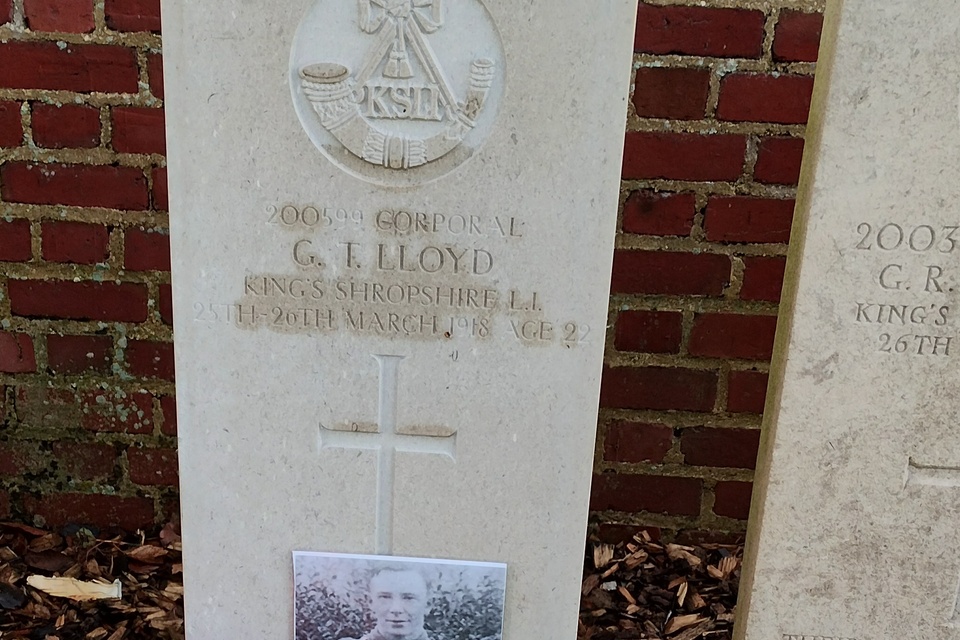
A British soldier who died during the First World War has finally been identified more than a century after his death, bringing an end to decades of uncertainty surrounding a grave previously marked as belonging to an unknown serviceman.
Corporal George Thomas Lloyd, who served with the King’s Shropshire Light Infantry, was killed on 26 March 1918 during fighting on the Western Front in France. He was just 22 years old.
For 108 years, his final resting place remained unidentified, despite his name being recorded among thousands of British soldiers commemorated as missing after the war.
Now, following years of historical research and an investigation involving the Ministry of Defence, the Commonwealth War Graves Commission and the National Army Museum, his grave has been formally identified.
A rededication ceremony took place on 17 November 2026 at Grevillers British Cemetery in France, where a new headstone bearing his name has replaced the marker that once identified him only as an unknown soldier.
The ceremony was organised by the Ministry of Defence’s Joint Casualty and Compassionate Centre, often referred to as the MOD War Detectives, whose work includes helping establish the identities of military personnel whose remains were never formally identified.
Who was Corporal George Thomas Lloyd?
George Thomas Lloyd was born on 13 March 1896 and joined the Territorial Army before the outbreak of the First World War.
When Britain entered the conflict in 1914, he was mobilised for military service with the King’s Shropshire Light Infantry, initially holding the rank of Private.
His military career took him far beyond Britain before he eventually reached the battlefields of France.
Lloyd arrived in India on 1 December 1914, where he began a period of overseas service that would continue across several parts of Asia.
In February 1915, he departed India for Singapore, spending the following years in the Far East.
By early 1917, he was working as a coach to the Signalling Section of the Hong Kong Volunteer Reserves, a role that reflected his involvement in military communications.
His experience with signalling would later become an important clue in the investigation that established the location of his grave.
After spending more than two years in Asia, Lloyd travelled towards Europe with his battalion as the war continued to claim lives across the Western Front.
From India and Hong Kong to the battlefields of France
The 1/4th Battalion of the King’s Shropshire Light Infantry landed in France on 27 July 1917 and initially served as part of the 190th Brigade.
The battalion took part in fighting during the Battle of Passchendaele in October 1917, one of the most notorious campaigns of the First World War.
The battle became associated with devastating casualties, difficult terrain and the harsh conditions faced by soldiers fighting in the trenches.
In February 1918, Lloyd’s battalion transferred to the 56th Brigade and moved into the Somme region of France.
By March, German forces were preparing a major offensive against Allied positions on the Western Front.
The fighting that followed would prove especially costly for Lloyd’s unit and ultimately lead to his death.
His journey from Shropshire through India, Singapore and Hong Kong to France illustrates the global reach of the First World War, which involved military personnel and resources from across the British Empire and beyond.
What happened to George Thomas Lloyd in March 1918?
Between 21 and 26 March 1918, the 1/4th Battalion of the King’s Shropshire Light Infantry suffered heavy losses during the German spring offensive.
The battalion lost 57 men over those six days, including Lloyd, who died on 26 March.
Of those killed, 39 were later commemorated on the Arras Memorial to the Missing because their burial locations could not be established after the war.
Lloyd was among those whose names were recorded on the memorial, with no confirmed grave where relatives or future generations could pay their respects.
The confusion surrounding burial locations was not unusual during the First World War.
Intense fighting, rapidly changing front lines and the destruction of battlefield landmarks made it extremely difficult to identify and recover every soldier who died.
Some bodies were buried hurriedly by military units or opposing forces, while others were recovered years later during battlefield clearance operations.
In Lloyd’s case, the key to identifying his grave lay in burial records dating back to 1920.
How an unknown soldier’s grave was linked to Lloyd
In September 1920, a burial plot within the German cemetery at Grevillers was examined as part of efforts to identify British soldiers buried there.
The plot had originally been marked by a single cross commemorating a group of unknown British servicemen.
Investigators exhumed the remains and examined evidence that could help establish the identities of the men.
The bodies were subsequently reburied in the same graves, which now form Plot XII, Row F, graves 1 to 34 at Grevillers British Cemetery.
Among the 34 casualties, seven were found with identification discs.
Other remains were associated with military items such as rank insignia, shoulder titles, trade badges and wound stripes.
Using the available evidence, investigators were able to identify 15 of the soldiers at the time.
All 15 were recorded as having died between 22 and 26 March 1918, placing their deaths within the period of intense fighting around Grevillers.
A further 12 casualties were linked to particular regiments, although their individual identities remained uncertain.
Of the 34 men, 13 were attributed to the King’s Shropshire Light Infantry.
Nine of those 13 had been identified as members of the 1/4th Battalion who died between 23 and 26 March 1918.
The remaining unidentified soldiers became central to the modern investigation.
The military badge that helped solve a century-old mystery
Among the unidentified men associated with the King’s Shropshire Light Infantry were two whose remains had been found with rank insignia.
One was identified as a Corporal and was also recorded as wearing a signaller’s badge.
That detail became particularly important because Lloyd had previously worked in military signalling during his service in Hong Kong.
The location of the burial plot, the dates of death and the regimental evidence all pointed towards soldiers who had died during the German advance through Grevillers in March 1918.
Historical evidence suggests the men were buried by German forces after they captured the area and began clearing the battlefield.
The combination of military rank, specialist insignia and known service history provided a basis for examining whether the unidentified Corporal could have been Lloyd.
Although no single clue established his identity on its own, the evidence became more persuasive when considered alongside the wider historical records.
Researchers reopen the case in 2020
The breakthrough began in 2020 when two researchers approached the Commonwealth War Graves Commission with evidence suggesting that the unidentified Corporal buried at Grevillers was George Thomas Lloyd.
Their findings prompted further investigation into the soldier’s service record, the circumstances of his death and the burial information recorded after the war.
The Commonwealth War Graves Commission worked alongside the National Army Museum and the MOD’s Joint Casualty and Compassionate Centre to examine the evidence.
The investigation ultimately confirmed the researchers’ conclusion that the grave belonged to Lloyd.
The identification demonstrates how historical records, military insignia and careful research can still resolve mysteries more than a century after the events occurred.
It also highlights the contribution of independent researchers whose work can provide new leads for organisations responsible for commemorating those who died in military service.
Emotional rededication ceremony held in France
A formal rededication service was held at Grevillers British Cemetery on 17 November 2026 to recognise Lloyd’s identity and commemorate his sacrifice.
The ceremony was organised by the Joint Casualty and Compassionate Centre, which works with military and historical organisations to identify previously unknown service personnel.
JCCC caseworker Alexia Clark thanked the researchers whose original evidence helped locate Lloyd’s grave.
She said the rededication had reunited the soldier’s remains with his name, ensuring that his sacrifice would not be forgotten.
The Commonwealth War Graves Commission replaced the previous headstone with one identifying Corporal George Thomas Lloyd.
The organisation will continue to maintain his grave as part of its responsibility for commemorating Commonwealth war dead.
For more than a century, Lloyd’s name had been associated with the missing. The new headstone now provides a confirmed place of burial and a lasting record of his identity.
Commonwealth War Graves Commission honours soldier’s remarkable journey
Dr Daniel Seaton, Commemorations Case Officer at the Commonwealth War Graves Commission, reflected on the extraordinary distance Lloyd travelled during his military service.
From India and Hong Kong to the Western Front, Lloyd’s wartime experience took him across several countries before his death in France.
Seaton said the identification now makes it possible to establish with certainty where that journey ended.
He also highlighted the significance of holding the ceremony during the remembrance period, when communities across Britain and other countries reflect on those who died during military conflicts.
The identification is a reminder that the work of commemorating the missing continues long after the wars themselves have ended.
Although the First World War ended in 1918, historical researchers and specialist organisations continue to investigate burial records and unidentified graves in an effort to restore names to those who lost their lives.
Why identifying unknown soldiers still matters today
More than a century after the First World War, the identification of an individual soldier may appear to be a small development compared with the scale of the conflict.
However, every confirmed identity helps restore a personal history that might otherwise remain incomplete.
For families, knowing the location of a relative’s grave can provide a tangible connection to someone whose death may have been remembered for generations without a known burial place.
For historians, such discoveries can also improve understanding of military movements, battlefield casualties and the circumstances in which soldiers were buried.
The work is particularly important because many soldiers died in conditions that made identification difficult, while surviving records were sometimes incomplete or damaged.
The case of Corporal Lloyd shows how evidence collected shortly after the war can become valuable again when examined alongside other historical information.
His rank, military unit, signalling experience and the location of the burial plot all contributed to resolving a mystery that had remained unanswered since 1918.
What Corporal Lloyd’s story means for Nigerians living in Britain
For Nigerians living in the UK, Corporal Lloyd’s identification offers an opportunity to look beyond the familiar images of European trenches and consider the wider international history of the First World War.
Lloyd’s service took him from Britain to India, Singapore and Hong Kong before he reached France, demonstrating how the conflict connected people and military institutions across different parts of the world.
That global history also includes Nigeria, which was under British colonial rule during the war.
Nigerian soldiers and carriers contributed to British military campaigns in Africa, including operations in German-controlled territories. Their service formed part of a wider wartime mobilisation involving African communities, although their experiences have not always received the same attention in popular accounts of the conflict.
For British Nigerians raising children in the UK, this provides a valuable starting point for discussing remembrance as a shared history rather than an event belonging exclusively to one country or community.
When schools mark Remembrance Day or families encounter war memorials in British towns, there is an opportunity to explore both the experiences of British soldiers such as Lloyd and the contributions made by people from Nigeria and other parts of the former British Empire.
The story is especially relevant to Nigerian families living in Shropshire and neighbouring areas, where the King’s Shropshire Light Infantry remains part of local military history.
A visit to a local museum, memorial or historical exhibition can help younger generations understand how the county’s wartime history connects with events across Africa, Asia and Europe.
For Nigerian students interested in history, genealogy or museum studies, Lloyd’s identification also illustrates the value of archival research. His grave was identified not through a new battlefield discovery but through the careful re-examination of records and evidence that had existed for decades.
There is a wider lesson here about whose stories are preserved and whose identities remain missing from the historical record.
At Chijos News, Corporal George Thomas Lloyd’s story reminds us that remembrance is not only about honouring the dead but also about recovering the individual lives behind military statistics. For Nigerians building their lives in Britain, understanding the country’s military history alongside Nigeria’s own wartime contributions can create a more complete picture of the connections between both nations.
Lloyd now has a named grave in France, 108 years after his death. His identification also invites a broader question worth exploring within the Nigerian diaspora: how many other soldiers, including those who served from African territories, still have stories waiting to be recovered from military archives and forgotten records?
The work of the MOD War Detectives and the Commonwealth War Graves Commission demonstrates that even after more than a century, historical research can restore a name, recognise a life and ensure that an individual’s sacrifice is no longer hidden behind the words “unknown soldier”.