
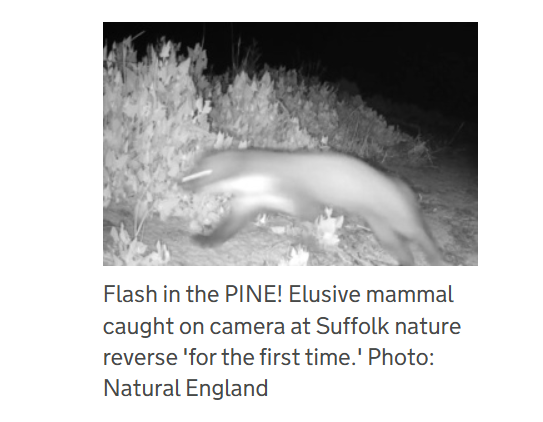
A rare and potentially historic wildlife sighting has been recorded on the Suffolk coast after a camera trap captured footage of what is believed to be a live pine marten at Benacre National Nature Reserve, near Lowestoft.
The footage was recorded on a beach at the nature reserve by a camera trap installed to monitor predators and disturbance affecting birds in the area. The discovery has excited conservationists because pine martens are elusive mammals that are rarely seen in England, and Natural England says this could be the first recorded sighting of a live pine marten in Suffolk.
Adam Burrows, senior reserve manager for Natural England, described the discovery as a major moment for those working at the reserve. He said seeing what they believe to be a pine marten in Suffolk for the first time demonstrates how special the landscape is and provides another indication of the wildlife supported by the protected site.
Pine martens are cat-sized mammals belonging to the mustelid family, which also includes animals such as weasels and stoats. They are generally difficult to spot because they are elusive and largely active at night. Their brown fur, light-coloured bib and distinctive bushy tail can help distinguish them from other similar mammals. Forestry England describes pine martens as shy animals that tend to avoid people, making camera traps an important way of monitoring their presence.
The possible sighting is particularly significant because pine martens were once widespread across Britain but suffered major population declines linked to habitat loss and historical persecution. They remain rare in England, although conservation work and natural recovery have helped the species begin to return to parts of the country. Natural England says the nearest previously recorded sighting to Benacre National Nature Reserve was at Heacham in Norfolk in 2024.
There is still an element of uncertainty surrounding the identification. Natural England has said the animal captured by the camera could potentially be a beech marten, which can look very similar to a pine marten. For that reason, the footage is being described as a sighting of what is thought to be a pine marten rather than a confirmed identification.
The camera trap will continue to be used at Benacre National Nature Reserve as part of ongoing monitoring of predators and disturbance. This work is particularly important during the breeding season because the reserve provides habitat for rare and threatened ground-nesting birds, including little terns and avocets. Monitoring wildlife activity allows conservationists to better understand how different species interact within the wider coastal ecosystem.
Benacre National Nature Reserve forms part of the protected habitats along the Suffolk coast and supports a wide range of wildlife. The reserve is home to more than 100 breeding bird species, including marsh harriers, bearded reedlings and bitterns, while its shingle shoreline supports plants such as yellow horned poppy and sea holly. The combination of coastal habitats, birds, plants and mammals makes the reserve an important part of efforts to support nature recovery in England.
The latest discovery also highlights the growing role of wildlife monitoring in understanding how species are recovering and moving across Britain. National monitoring programmes now bring together records from professional surveys, camera traps and members of the public, helping conservation organisations build a clearer picture of where pine martens are being recorded and how their populations are changing.
Natural England is also delivering the King’s Series of National Nature Reserves, an initiative aimed at creating or extending 25 National Nature Reserves by 2027. The programme is intended to protect important habitats and species while supporting nature recovery on a wider landscape scale.
For people visiting Suffolk and other protected areas, the possible pine marten sighting is another reminder that Britain’s countryside can contain wildlife that is rarely encountered in everyday life. While pine martens are protected and naturally avoid people, sightings and photographic evidence can provide useful information for conservation monitoring, particularly when shared through recognised wildlife recording programmes.
For Nigerians living in the UK, discoveries such as this offer a different way of connecting with the country beyond the usual headlines about immigration, work, housing and the economy. Many Nigerians in Britain live, study or work in towns and cities close to some of the UK’s most important parks, coastlines and nature reserves, and understanding these places can make life in the UK feel more familiar and connected to the wider community. For Nigerian families raising children in Britain, wildlife discoveries such as the possible Suffolk pine marten can also become opportunities to explore the country’s natural environment, visit protected landscapes and help younger generations understand the wildlife and conservation efforts around them. Chijos News brings Nigerians in the UK practical information and stories that help them understand not only the policies and opportunities that affect their lives, but also the communities, places, culture and changing environment they now call home.