
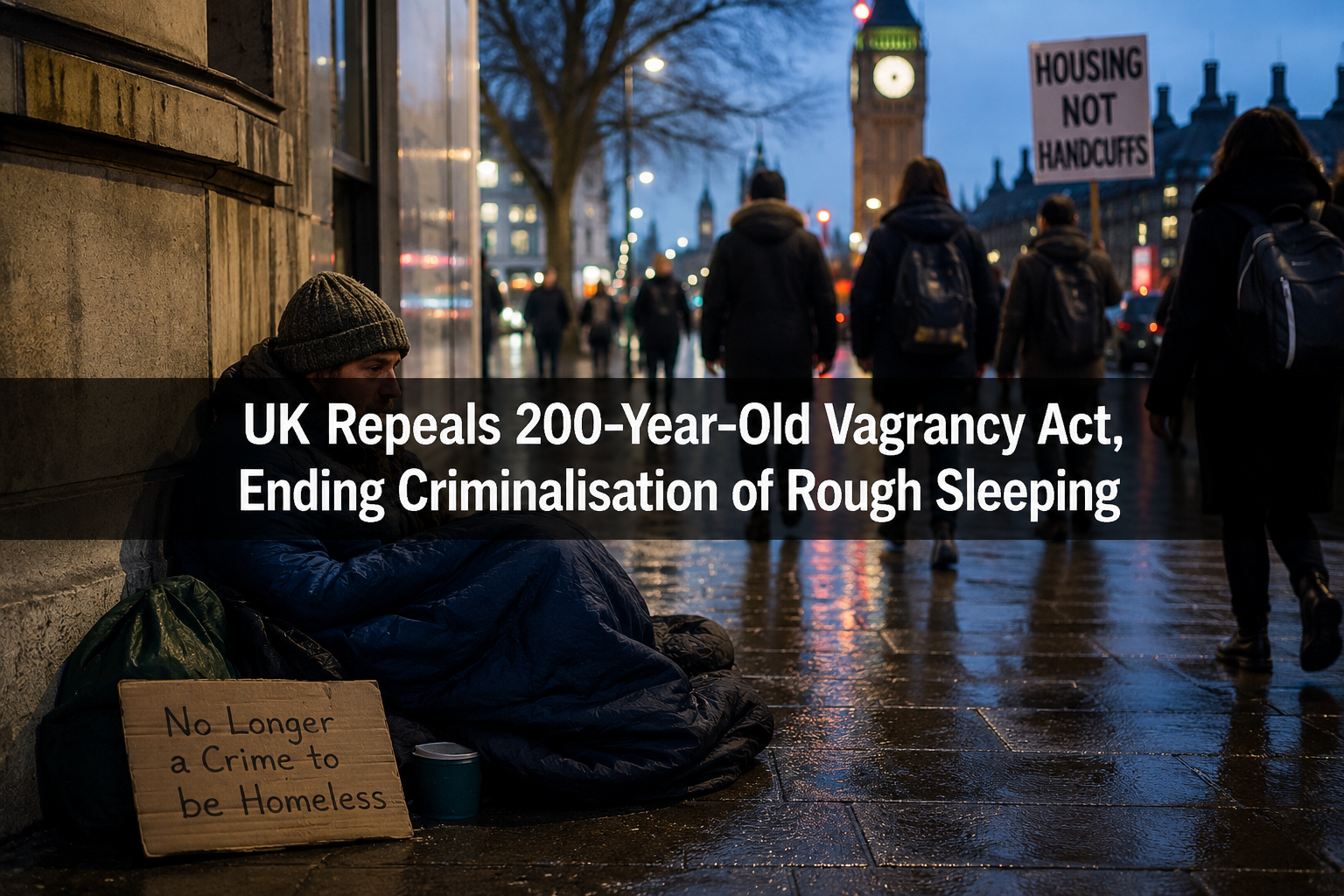
The UK government has officially repealed the historic Vagrancy Act, bringing an end to nearly 200 years of legislation that criminalised rough sleeping and begging in England and Wales. The landmark decision, which takes effect on Monday, 29 June, marks a major shift in the country’s approach to homelessness by replacing punishment with prevention, support, and long-term housing solutions.
The repeal ends a law that has been widely criticised by charities, homelessness organisations, and campaigners for penalising vulnerable people simply because they had nowhere to live. Introduced in 1824 following the Napoleonic Wars and the Industrial Revolution, the Act allowed authorities to prosecute people for sleeping rough or begging, often leaving those already facing hardship with criminal records that made rebuilding their lives even more difficult.
The government says abolishing the legislation is a key milestone in its wider National Plan to End Homelessness, which is backed by £3.6 billion over the next three years. The strategy aims to halve long-term rough sleeping before the end of the current Parliament while also ending the unlawful use of bed and breakfast accommodation for families experiencing homelessness.
Alongside the repeal, ministers are investing heavily in increasing the supply of affordable housing. A separate £39 billion programme over the next decade has been described as the largest long-term investment in social and affordable housing in a generation. Recent government figures indicate that starts on social and affordable housing projects have increased by 35 percent since 2024, while completions have also continued to rise.
The announcement comes after Britain experienced a week of exceptionally high temperatures, prompting officials to remind the public about the StreetLink service, which allows people to alert local authorities when they see someone sleeping rough so outreach teams can offer support.
Housing Secretary Steve Reed described the repeal as a significant change in how society responds to homelessness.
“Homeless people are not criminals, they are people who need help.”
He said the government was moving away from outdated policies that punished vulnerable individuals and instead focusing on preventing homelessness through sustained investment and practical support.
Homelessness Minister Alison McGovern echoed those views, describing the repeal as long overdue and reflective of a modern understanding of homelessness.
She said the government was abandoning a centuries-old approach that failed to address the underlying causes of rough sleeping and was instead concentrating on prevention, support services, and helping people secure permanent homes.
The National Plan to End Homelessness includes significant new investment in frontline services. A £159 million supported housing grant is expected to help more than 2,500 people move off the streets into stable accommodation while preventing others from becoming homeless in the first place.
The strategy also introduces clear national targets, including halving the number of people who become homeless immediately after leaving prison and ensuring that no eligible person is discharged from hospital directly onto the streets. Ministers have also set a long-term ambition that no individual should become homeless after leaving any public institution.
The forthcoming Social Housing Bill is expected to strengthen protections for victims of domestic abuse living in social housing. Research indicates that almost 70 percent of women experiencing rough sleeping in 2025 had suffered domestic abuse since the age of 16, highlighting the close relationship between housing insecurity and domestic violence.
While the Vagrancy Act has been repealed, ministers stressed that police and local authorities will continue to have powers to deal with antisocial behaviour where necessary. Existing legislation under the Anti-Social Behaviour, Crime and Policing Act 2014 will remain available to address behaviour that causes harassment or distress, rather than targeting people solely because they are homeless.
The government also reaffirmed its commitment to tackling organised criminal activity linked to begging. New offences introduced under the Crime and Policing Act 2026 will target organised begging gangs, individuals who exploit vulnerable people for financial gain, and criminal trespass associated with organised crime.
Homelessness charities have welcomed the repeal as one of the most significant reforms in decades.
Matt Downie, Chief Executive of Crisis, described the move as a watershed moment that finally ends what he called a deeply cruel policy of criminalising people simply because they had nowhere safe to sleep.
He said the repeal follows decades of campaigning by charities, politicians, law enforcement agencies, and people with lived experience of homelessness. According to Downie, the decision sends a powerful message that homelessness should be addressed through compassion and support rather than punishment.
Emma Haddad, Chief Executive of St Mungo’s, also welcomed the decision, saying outreach teams regularly witness how criminalisation discourages vulnerable people from accessing the support services they desperately need. She said many rough sleepers avoid engaging with authorities because of previous negative experiences, making it even harder to help them rebuild their lives.
Bonnie Williams, Chief Executive of Housing Justice, said repealing the Act should represent more than the removal of an outdated law. She argued it should signal a broader transformation in how society approaches homelessness by recognising that recovery involves not only secure housing but also relationships, community, dignity, and belonging.
Rick Henderson, Chief Executive of Homeless Link, described the repeal as a landmark achievement that demonstrates the government’s commitment to replacing crisis-driven responses with prevention, joined-up public services, and long-term support. He said rough sleeping should never be treated as a crime but recognised as evidence that support systems have failed those most in need.
Alongside legislative reform, the government continues to expand practical support through several major funding programmes. These include a £37 million Ending Homelessness in Communities Fund supporting charities, voluntary organisations, and faith groups delivering frontline services, a £15 million Long-Term Rough Sleeping Innovation Programme targeting areas facing the greatest challenges, and almost £1 billion to improve temporary accommodation while reducing the use of unsuitable bed and breakfast accommodation for families.
The government’s wider housing reforms also include the abolition of Section 21 no-fault evictions through the Renters’ Rights Act, a measure ministers believe will prevent thousands of people from becoming homeless by giving tenants greater security in the private rented sector.
With the repeal of the Vagrancy Act, the government says Britain is closing one of the oldest chapters in its legal history and replacing it with a system that prioritises housing, prevention, dignity, and long-term recovery for those experiencing homelessness.
At Chijos News, we go beyond the headlines to explain how major UK policy changes affect diaspora communities. From housing and immigration to social welfare, education, employment, and public services, we provide trusted reporting that helps Nigerians, Africans, and other diaspora communities understand the policies shaping everyday life in Britain while keeping them informed about developments that matter both at home and abroad.