
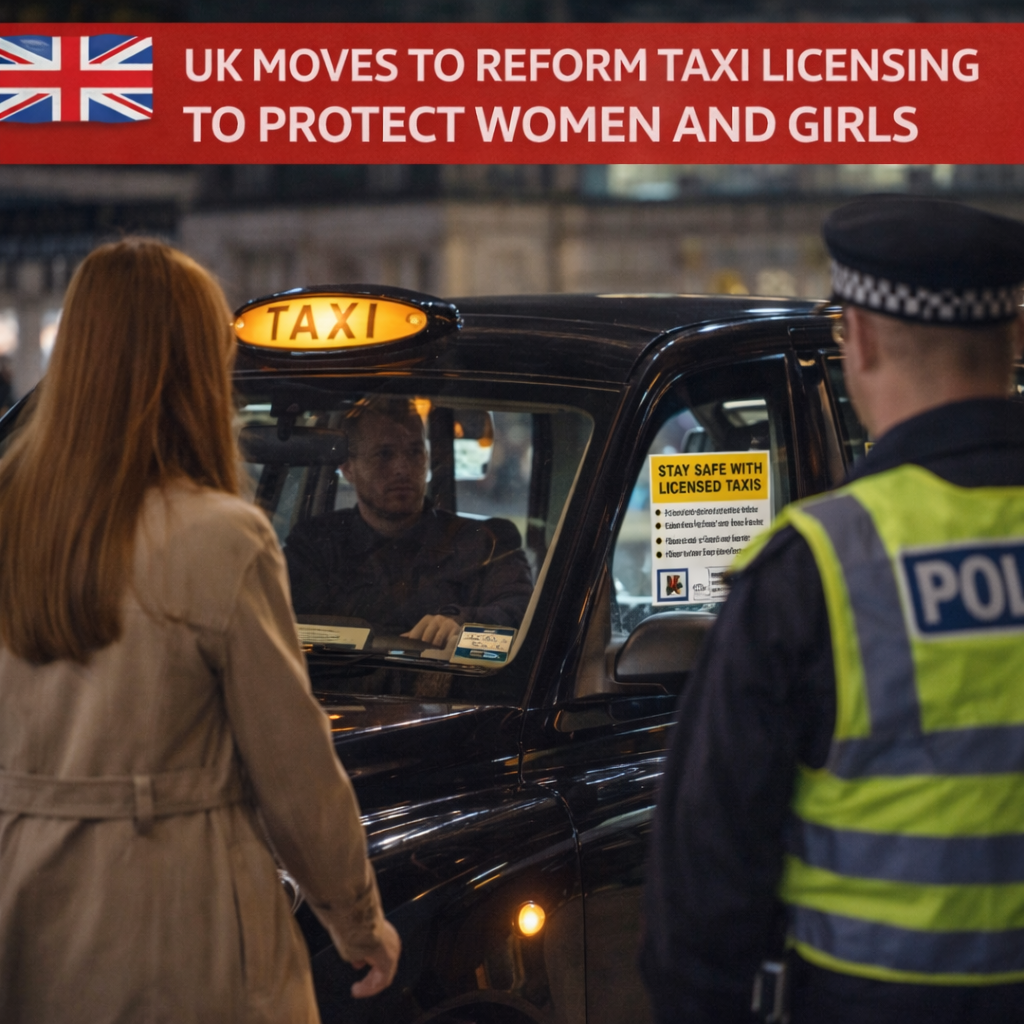
Women and girls across the UK could soon benefit from stronger protections when using taxis and private hire vehicles, as the government moves to overhaul a fragmented licensing system that has long raised safety and enforcement concerns.
Under new proposals announced by the Department for Transport on 8 January 2026, responsibility for licensing taxi and private hire drivers would be streamlined from the current 263 authorities down to 70 local transport authorities. These bodies already oversee local transport planning and would take on licensing duties under the new system.
The changes are designed to clamp down on so-called “out-of-area” working, a practice where drivers licensed in one council area operate mainly elsewhere. This has created safety risks, enforcement gaps and unfair competition, particularly in large urban areas. By reducing the number of licensing bodies, the government says drivers will have fewer opportunities to shop around for areas with weaker checks or lower standards.
In places like Greater Manchester, where there are currently 10 separate licensing authorities, the proposals would reduce this to a single authority. Ministers believe this would make enforcement clearer, faster and more consistent, giving passengers greater confidence regardless of where they travel.
The proposals form part of the government’s wider response to Baroness Casey’s National Audit on Group-Based Child Sexual Exploitation and Abuse, which highlighted how out-of-area working can undermine safeguarding efforts. The audit called for tougher, more consistent statutory standards for taxi and private hire licensing, a recommendation the government says it is now acting on.
Local Transport Minister Lilian Greenwood said passenger safety is at the heart of the proposals. She said that moving licensing to local transport authorities, alongside the introduction of national minimum standards, would improve consistency and strengthen enforcement across the country, helping to make taxis and private hire vehicles as safe as possible.
Industry groups have also welcomed the consultation. A spokesperson for the Licensed Private Hire Car Association said reducing the number of licensing authorities would improve efficiency and create more consistent standards nationwide, ultimately benefiting public safety and trust.
For many diaspora communities, taxis and private hire vehicles are a vital part of daily life, particularly for women, young people and those working late or irregular hours. Concerns about safety, accountability and driver checks are especially significant for families who rely heavily on these services in major cities.
Alongside the licensing reforms, the government is also consulting on new national minimum standards for taxi and private hire licensing. If introduced, the Transport Secretary would have the power to ensure that all drivers meet robust checks, regardless of where they are licensed. This would mean passengers could expect the same level of safety and regulation whether they are travelling locally or across council boundaries.
The public consultation will run for 12 weeks and is available on GOV.UK. The government says feedback from passengers, drivers, councils and community groups will play a key role in shaping the final reforms.
As a diaspora-focused platform, Chijos News will continue to track how these proposals develop and what they mean for safety, fairness and trust in public transport across the UK.