
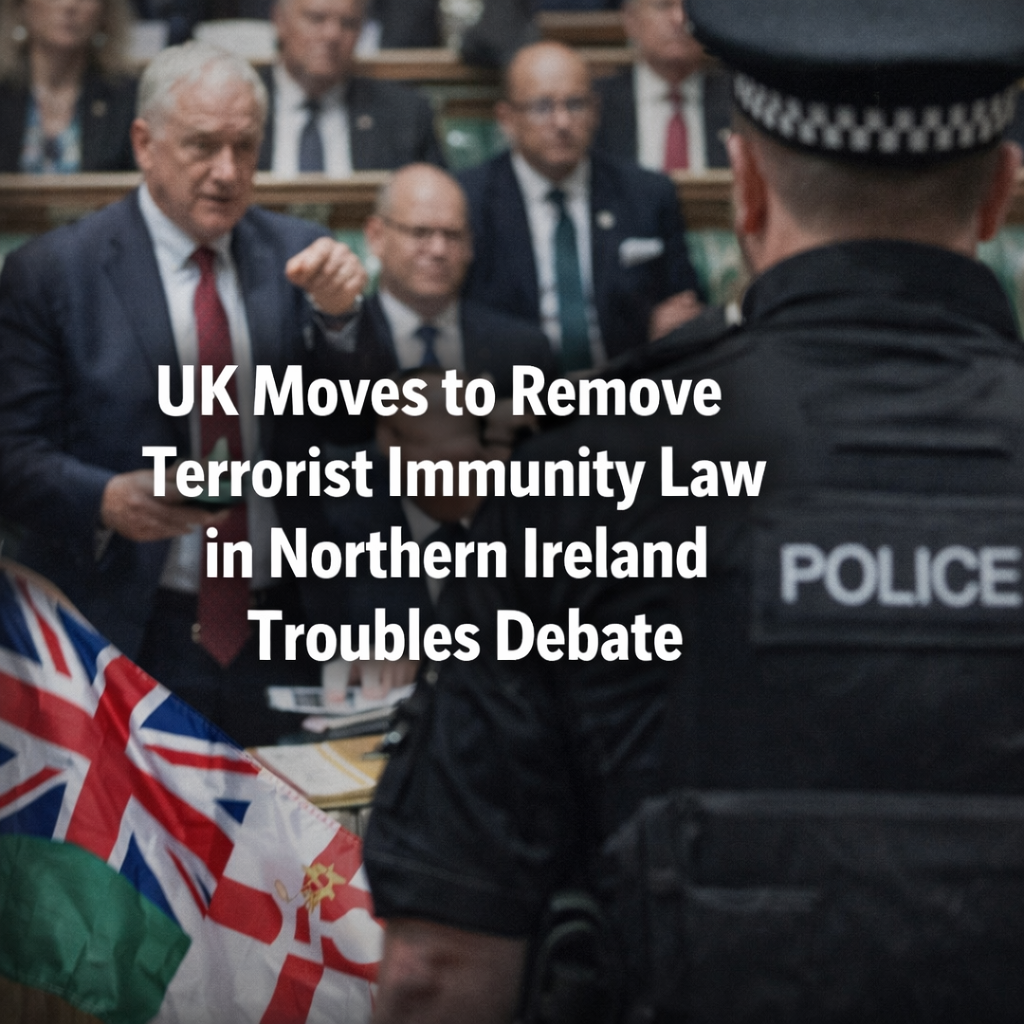
The UK Government is taking a decisive step to undo one of the most controversial aspects of recent Northern Ireland legacy legislation, as the Secretary of State for Northern Ireland, Hilary Benn, asks MPs to support the removal of provisions that could have allowed terrorists to receive immunity for killings committed during the Troubles.
Today’s debate in the House of Commons marks a significant moment in the Government’s effort to dismantle and replace the previous administration’s Northern Ireland Troubles (Legacy and Reconciliation) Act, a law that sparked outrage across Northern Ireland and among victims’ families for appearing to prioritise political closure over justice.
At the centre of the debate is a Remedial Order designed to fix two key elements of the Act that were found to be incompatible with human rights law. One is the uncommenced conditional immunity scheme, which would have allowed individuals involved in Troubles-related killings to avoid prosecution under certain conditions. The other is the removal of the ban on new civil claims, which had blocked families from seeking justice through the courts.
For many communities in Northern Ireland, these provisions were not just legally flawed but morally indefensible. The idea that those responsible for terrorist violence could receive immunity if they cooperated with a state-led process deeply damaged trust and reopened old wounds. Victims’ families argued that the law stripped them of their long-standing right to pursue truth and accountability through the justice system.
Speaking ahead of the debate, Hilary Benn made clear that the Government believes the Legacy Act went too far in the wrong direction. He described the provisions being removed as legally defective and harmful to public confidence, stressing that restoring trust is essential if any new legacy framework is to work.
The Government has also been careful to separate the issue of terrorist accountability from the treatment of former service personnel. Ministers have repeatedly emphasised that there can be no moral equivalence between those who served in the security forces and the terrorist organisations responsible for the vast majority of Troubles-related deaths. According to official figures, around 90 percent of those killed during the Troubles were victims of terrorist violence.
For Nigerians and other members of the UK diaspora watching from outside Northern Ireland, this distinction matters. The Troubles are often discussed in abstract historical terms, but for families affected by the violence, the consequences remain deeply personal. Many still live with unanswered questions, unresolved grief and a sense that justice was never fully delivered.
Alongside the Remedial Order, the Government says it is strengthening protections for Northern Ireland veterans through its wider Troubles Bill. These measures are intended to reduce the fear of repeated investigations in old age and to provide greater certainty and dignity for those who served. The aim, ministers say, is to protect veterans from unnecessary distress while ensuring that serious crimes are not simply written off.
David Crabbe OBE, President of Decorum NI, welcomed the move while warning against using veterans as political tools. He stressed that former service personnel are real people who also carry trauma from the past and deserve fair treatment. At the same time, he underlined that victims and survivors of the Troubles deserve answers, even if true closure is never possible.
For many families, the right to seek truth through civil cases is not about revenge but recognition. It is about acknowledgement, accountability and the hope that future generations will not inherit the same uncertainty that has lingered for decades.
The Government says today’s debate is only the first step in a broader process to rebuild a Northern Ireland legacy framework that aligns with the Good Friday Agreement and respects human rights. Any long-term solution, ministers argue, must balance fairness to veterans with the fundamental rights of victims and their families to pursue justice.
For the Nigerian diaspora and wider Black British communities, this moment offers a reminder of how deeply the rule of law matters in a democratic society. Laws that appear to protect perpetrators at the expense of victims can erode trust not just in government, but in justice itself. The UK’s willingness to revisit and correct such legislation signals the importance of accountability, even when history is painful and politically complex.
At Chijos News, we continue to break down complex UK policies and political decisions for diaspora audiences, explaining not just what is happening, but why it matters. Understanding debates like this helps immigrants and minorities better grasp the values, tensions and responsibilities that shape public life in the UK.
As Parliament debates the future of Northern Ireland’s past, one message is clear: lasting peace cannot be built on legal shortcuts. It must be grounded in fairness, truth and respect for the rights of all citizens.