
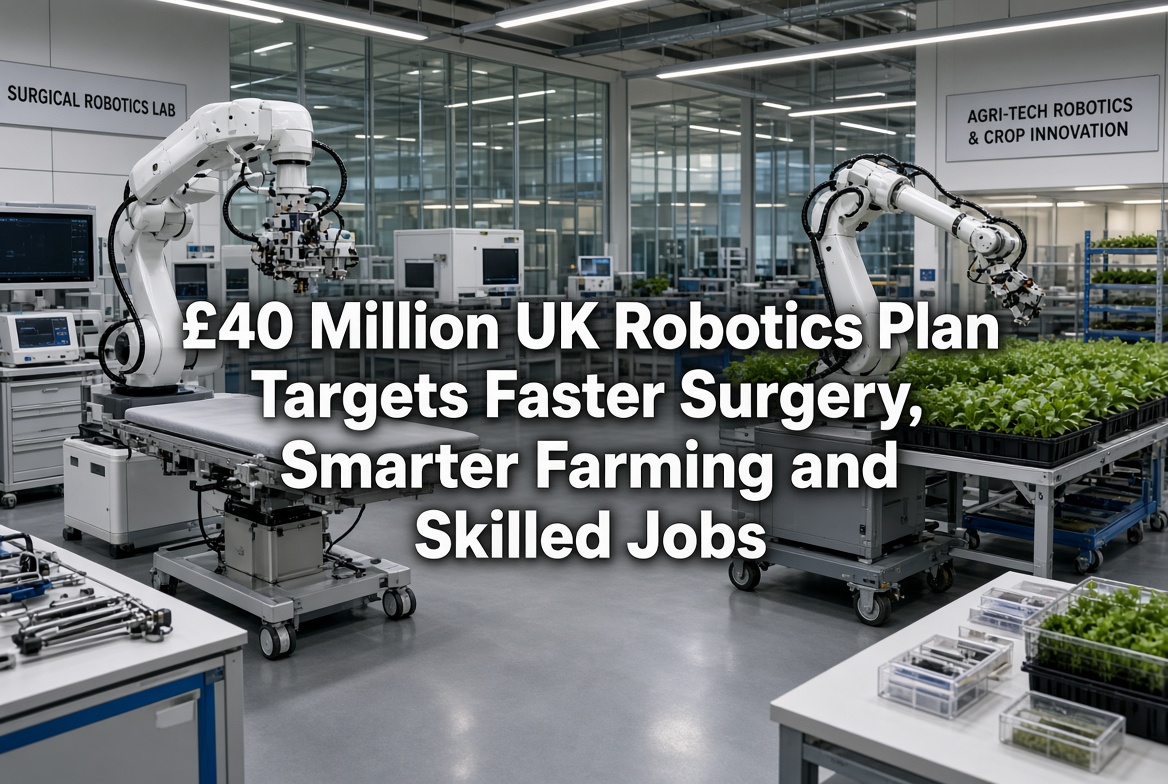
The UK Government is investing in a new network of robotics hubs designed to help businesses adopt advanced technology, improve productivity and create skilled jobs, with potential benefits ranging from faster patient recovery after surgery to more efficient food production.
Backed by £40 million, eight Robotics Adoption Hubs are being launched across the UK to help businesses and public services understand how robotics and autonomous technology can be used in practical, real-world settings. The programme will provide expert advice, hands-on demonstrations and support for organisations that want to introduce automation but are unsure where to start.
The initiative, announced on Friday, 9 October 2026, is intended to make it easier for UK businesses to adopt robotics technology and benefit from developments in artificial intelligence, manufacturing, healthcare, farming, logistics and transport. The government says the hubs will help turn technological innovation into improvements that people and businesses can see in everyday life.
Robotic surgery could help patients recover faster
One of the programme’s major areas of focus is healthcare, where robotic surgical assistants could help clinicians carry out certain procedures with greater precision and less invasive techniques. Depending on the operation and the technology used, less invasive surgery can reduce recovery time and help some patients return home sooner.
The National Surgical Robotic Adoption Hub, known as SHARP, will focus on supporting the safe and effective adoption of surgical robotics. Its work will include evidence-based implementation and efforts to improve access to innovative surgical care.
The aim is to help healthcare organisations understand which technologies are suitable for their needs, how they should be introduced and what evidence is available about their benefits. Robotics will not replace the need for trained surgeons and clinical teams, but the technology may support them in delivering particular procedures and improving patient care where it is appropriate.
The investment comes as healthcare services continue to explore ways to improve efficiency, manage demand and make better use of specialist skills. The programme’s practical approach is designed to help organisations assess both the potential benefits and the costs before committing to new equipment.
Robotic farming could help get more food from farms to shops
Agriculture and food production are another major focus of the new hubs. In Lincoln, the HARVEST hub will help businesses across the agri-food sector explore robotics, including technologies for arable farming, fruit and vegetable production and food manufacturing.
Automated fruit-picking machines and other agricultural robots could reduce the time needed for some harvesting tasks and help farmers manage labour-intensive work. By taking on repetitive activities, automation may allow agricultural workers to concentrate on other essential jobs involved in maintaining crops, managing land and increasing production.
The hub will provide testing facilities and practical support to help businesses understand how robotics can work in real farming and food-production environments. The intention is to address barriers that can prevent companies from adopting new technology, including technical challenges, commercial costs, regulation and workforce training.
For the wider food supply chain, more efficient production could help businesses manage resources and improve operations between farms, processing facilities and retailers. However, the actual benefits will depend on the technology being used, the type of farm or business and whether the investment makes commercial sense.
Where will the eight Robotics Adoption Hubs operate?
The new network brings together specialist projects designed to address different industries and regional needs. Alongside SHARP in surgical robotics and HARVEST in agriculture and food production, the Greater Southwest Robotic Adoption Hub will help businesses explore automation through expert advice, industry connections and practical demonstrations.
The Milton Keynes Robotics Adoption Hub will focus on robotics in public spaces and the use of service robots, drones and self-driving vehicles across transport, logistics and delivery services. In Wales, Hwb Llwybr Roboteg Cymru, also known as the Robotics Pathway Hub, will help manufacturers assess robotics investments, improve productivity and build confidence in automation.
The National Waste and Recycling Robotics Adoption Hub will help waste and recycling sites test technology designed to recover more materials, reduce the amount sent to landfill and support skilled employment. The Yorkshire Robotics Adoption Hub will provide manufacturers with independent guidance, feasibility studies, demonstrations, workforce training and support for deploying proven robotics systems.
A further hub in South Wales will bring together partners offering independent advice, testing before investment, technical support and skills development for businesses considering automation. Together, the eight hubs are intended to make specialist expertise more accessible to companies that might otherwise struggle to evaluate or adopt robotics technology.
Government says robotics could add £150 billion to the UK economy
The government says robotics and autonomous systems could contribute £150 billion to the UK economy by 2035 if adoption is maximised. At current adoption levels, the estimated contribution stands at £6.4 billion, highlighting the potential gap between what the technology could deliver and how widely it is currently being used.
Minister for AI Kanishka Narayan said robotics could help patients recover faster, give businesses more time to focus on important work and increase the amount of food reaching consumers. He argued that many businesses are interested in new technology but lack the guidance needed to understand where to begin.
The new hubs are intended to close that gap by connecting organisations with specialists who can explain the costs, benefits and practical requirements of introducing automation. They will also help businesses identify suitable technology suppliers, systems integrators and finance providers.
Bruce Adderley, Director of Advanced Manufacturing at Innovate UK, said robotics could improve productivity, strengthen public services and support economic growth. He said the hubs would connect advanced technology with organisations capable of benefiting from it, drawing on regional expertise to support investment, jobs and stronger local economies.
New funding will help workers develop robotics skills
Alongside the eight adoption hubs, the programme includes £1.7 million for a national body designed to bring the hubs together, share knowledge and help maximise the impact of investment. Known as Accelerating UK Robotics Adoption, or AURA, the initiative will be delivered by The Welding Institute in partnership with Anglia Ruskin University.
A further £2.5 million will support 12 projects focused on robotics training, professional development, apprenticeships and workforce outreach. The funding is intended to address a shortage of workers with the skills needed to select, purchase, integrate, operate and maintain robotics systems.
The projects include practical training for engineers and technicians, robotics programmes for ports and logistics, maritime autonomy training, and initiatives to help manufacturers introduce automation safely. Other schemes will support business leaders in understanding robotics investment, help schools introduce robotics education and explore apprenticeship routes for future robotics technicians.
This training element is important because buying advanced equipment is only part of the challenge. Businesses also need people who can operate the technology, maintain it safely and adapt existing processes around it. Without those skills, organisations may struggle to achieve the productivity improvements that automation promises.
By combining technology demonstrations with training and workforce development, the programme aims to help businesses move from considering robotics to putting it into effective use.
What the robotics investment could mean for UK businesses
The new hubs are intended to help businesses assess robotics before committing significant sums to new equipment. Through demonstrations, feasibility studies and specialist advice, organisations will be able to explore whether automation is suitable for their operations and how it might affect productivity, staffing, safety and costs.
The programme also builds on existing UK robotics facilities, including the National Robotarium in Edinburgh, the nuclear robotics collaboration RAICo in Whitehaven and the Manufacturing Technology Centre in the West Midlands. The additional hubs are expected to complement this wider network by providing more targeted support for businesses in different industries and regions.
The government hopes that better access to expertise will encourage more companies to adopt proven technologies, attract investment and strengthen Britain’s position in advanced manufacturing and automation. Whether the £150 billion economic potential can be realised will depend on how widely businesses adopt robotics, the availability of skilled workers and the commercial results achieved by individual projects.
For now, the programme represents a significant effort to make robotics more accessible beyond large technology companies and specialist research institutions, bringing practical support closer to manufacturers, farmers, healthcare providers and other organisations across the country.
For Nigerians living and working in the UK, the expansion of robotics and automation could create opportunities to explore new career paths as British industries invest in advanced technology. The programme’s funding for robotics training, apprenticeships and workforce development is particularly relevant to Nigerian graduates, engineers, technicians and career changers who want to build skills that are increasingly important in manufacturing, logistics, agriculture and technology.
The hubs may also be useful to Nigerian-owned businesses operating in Britain, especially manufacturers, food businesses and companies involved in distribution or logistics. Access to independent advice and practical demonstrations could help eligible businesses assess whether automation would reduce repetitive work, improve efficiency or make operations more competitive. The funding does not mean every business will receive a grant or that every hub will provide direct financial support, so companies should check the specific services and eligibility criteria offered by each project.
For Nigerian parents raising children in the UK, the investment is also a reminder that future employment opportunities will increasingly involve technology, digital skills and the ability to work alongside automated systems. Following developments in robotics training, apprenticeships and technical education can help families understand which skills may be valuable as the labour market changes.
Chijos News will continue to track UK developments in technology, business and employment that matter to the Nigerian diaspora, including new training routes, emerging industries and opportunities for Nigerian professionals and entrepreneurs to participate in Britain’s changing economy.