
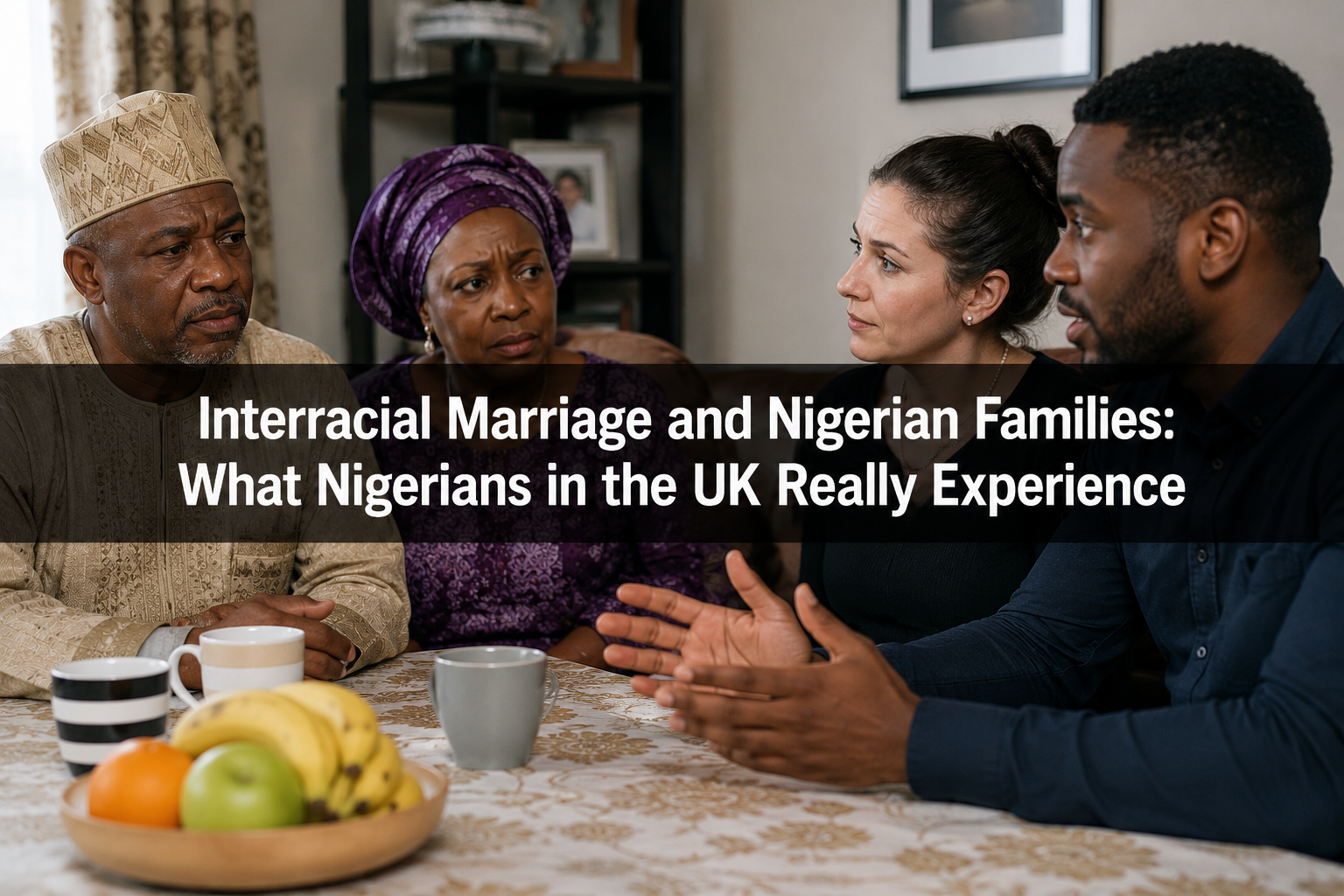
Interracial marriage is one of those topics that can transform an ordinary Nigerian family conversation into a passionate debate filled with opinions, emotions and deeply held beliefs. It sits at the crossroads of love, culture, identity, family expectations and tradition. For Nigerians living in the United Kingdom and across the wider diaspora, it is no longer a distant concept or an unusual occurrence. It is part of everyday life.
People meet through work, university, church, social events, professional networks and online platforms. Relationships form naturally across racial and cultural lines. Yet for many Nigerians, the moment a relationship becomes serious, it often stops being just about two people. Suddenly, parents, grandparents, aunties, uncles and even family friends become interested stakeholders. Questions begin to emerge almost immediately. Where is your partner from? Does their family understand our culture? Will they accept our traditions? How will the children be raised? Behind those questions are fears, hopes, assumptions and experiences that many families rarely discuss openly.
The reality is that Nigerian attitudes towards interracial marriage are far more complicated than simple approval or disapproval. Some families embrace it wholeheartedly. Others remain cautious. Some resist openly, while others quietly struggle with concerns they cannot easily express. Understanding these reactions requires looking beyond stereotypes and examining the emotional realities behind them.
The First Conversation Often Reveals Everything
When a Nigerian son or daughter announces they are dating someone from a different racial background, the first response often reveals deeper feelings than people realise. Some parents respond with enthusiasm and genuine curiosity. Others become cautious, asking detailed questions that may feel like an interrogation. A few react with visible anxiety.
These reactions are usually shaped by personal experiences, cultural exposure, generational differences and fears about the future.
Take the example of Chika, who moved from Lagos to the UK for university and later met a white British colleague. When she told her mother about the relationship, there was a long silence before her mother finally asked whether he was serious about her. On the surface, it seemed like a simple question. In reality, it reflected concerns about commitment, cultural understanding and whether her daughter was entering a relationship built on genuine long-term intentions.
Similarly, Ibrahim, a Nigerian man living in Manchester, introduced his Caribbean British partner to his family. His father’s immediate response was that culture might not be too difficult because she was Black. While intended positively, the comment revealed how many Nigerian families often blend ideas about race and culture together, even when the realities are much more complex.
The Fear of Being Looked Down Upon
One concern that rarely receives enough attention is the fear many Nigerian families have about acceptance. This is particularly common when the other partner comes from a white British or Western background.
Many parents carry memories of racism, discrimination and historical inequalities. They worry that their child could enter a family environment where they are tolerated rather than fully embraced. They worry about subtle prejudice. They worry that their accents, traditions, food and values could be viewed as strange or inferior.
Ada, a Nigerian professional engaged to a British man, discovered that her father’s greatest concern was not cultural loss. Instead, he repeatedly asked whether her future in-laws respected her and respected her family. His questions reflected a deeper fear that his daughter might one day feel pressured to hide parts of her Nigerian identity in order to fit in.
At the same time, some Nigerian families worry about how the wider Nigerian community will respond. Interracial marriage can attract comments suggesting someone has abandoned their roots or believes they are better than others. These reactions often reveal insecurities that have little to do with the relationship itself.
Culture Remains the Biggest Question
For many Nigerian families, race is not actually the central issue. Culture is.
Parents often worry about whether a future spouse will understand family obligations, respect for elders, traditional ceremonies, religious expectations and communal values. They wonder whether their customs will survive within the marriage or gradually disappear.
Ibrahim’s family wanted a traditional engagement ceremony complete with customary rites and symbolic bride price discussions. His British partner’s family had never experienced anything similar. Questions arose immediately about what the traditions meant and why they mattered. Initially there was confusion on both sides. Eventually, through patient conversations and mutual respect, they created a ceremony that honoured both cultures.
Small gestures can carry enormous meaning. Something as simple as learning how to greet elders respectfully or participating in a traditional ceremony can help build trust. These actions demonstrate a willingness to embrace family culture rather than simply tolerate it.
Religion Can Matter More Than Race
In many Nigerian households, religion often outweighs racial considerations.
Families that are deeply Christian or Muslim frequently place enormous importance on shared beliefs. For some parents, the first question about a partner is not their race but their faith.
Bisi, who grew up in a Pentecostal Christian family, found herself navigating difficult conversations when she began dating a British man who described himself as spiritual but not religious. Her mother’s concerns centred almost entirely on faith. Questions about future children, church attendance and shared values quickly became the focus.
Interestingly, many Nigerian families would be more comfortable with a partner from a different race who shares their religious beliefs than with someone from the same ethnic background who does not.
This highlights how identity within Nigerian families is often shaped by multiple layers beyond race alone.
The Extended Family Effect
One reality of Nigerian family life is that marriage rarely involves only parents and children.
Extended family members often feel entitled to contribute opinions, advice and warnings. Interracial relationships can become topics of discussion among grandparents, cousins, aunties, uncles and even neighbours.
Some relatives offer support and encouragement. Others introduce stereotypes and fears that can influence the broader family conversation.
A single negative comment repeated often enough can create doubt even among previously supportive family members. This places additional pressure on couples who are already navigating cultural differences.
At the same time, some extended family members surprise everyone by becoming the strongest supporters. Exposure often changes perspectives more effectively than arguments ever could.
Read Also: Relationship Shocks Nigerians Face in the UK: Love, Marriage, Dating and Diaspora Reality
Stereotypes Exist on Both Sides
It is important to acknowledge that stereotypes and prejudice sometimes influence reactions to interracial marriage.
Some Nigerian families hold assumptions about other racial groups that are based on limited exposure or second-hand stories. Likewise, families from other backgrounds may carry misconceptions about Nigerians and African cultures.
These stereotypes can create tension, misunderstanding and unnecessary conflict.
The challenge for couples is often not simply managing cultural differences but helping family members move beyond assumptions. This requires patience, honest conversations and a willingness to confront uncomfortable truths.
Many families eventually grow through this process. Others remain resistant. The outcome often depends on the willingness of individuals to engage with each other as people rather than stereotypes.
The Question of Children
Few topics generate more discussion within Nigerian families than future children.
Parents and grandparents often worry about identity, language, heritage and cultural continuity. They wonder whether grandchildren will know their Nigerian roots, speak their language or maintain connections with family traditions.
For many older Nigerians, these concerns are not about controlling the next generation. They are about preserving a sense of belonging.
Couples who openly discuss these issues often find it easier to reassure family members. Decisions about names, cultural traditions, visits to Nigeria and language learning can become meaningful bridges between generations.
When grandparents see that their heritage is not being erased, many of their fears begin to fade.
Acceptance Often Takes Time
One of the most encouraging realities is that many Nigerian families eventually change their views.
Initial resistance frequently softens as parents observe the relationship over time. When they see genuine love, mutual respect and commitment, many begin to reassess their assumptions.
Relationships have a way of humanising what once felt unfamiliar.
The partner who was once viewed with suspicion gradually becomes part of the family. Shared meals, celebrations, challenges and milestones build trust in ways that no argument ever could.
This transformation does not happen overnight. Sometimes it takes years. But it happens more often than people realise.
When Acceptance Never Fully Comes
Not every story has a perfect ending.
Some families never completely embrace interracial relationships. They may remain polite but distant. They may continue making subtle comments or maintain emotional barriers.
For couples, this can be deeply painful. It forces difficult decisions about boundaries, expectations and emotional wellbeing.
In such situations, protecting the health of the relationship becomes essential. While family approval is valuable, it cannot become the sole foundation on which a marriage stands.
Love, Identity and the Modern Nigerian Story
Interracial marriage is increasingly becoming part of the Nigerian experience, particularly within diaspora communities. It reflects the reality of a world where people from different backgrounds meet, connect and build lives together.
For Nigerian families, these relationships often challenge long-held assumptions about identity, culture and belonging. Sometimes that challenge creates conflict. Sometimes it creates growth. Often it creates both.
What remains constant is the desire many parents have to protect their children, even when that protection is expressed imperfectly. Understanding this can help couples approach difficult conversations with empathy while still remaining firm in their choices.
Interracial marriage does not have to mean abandoning Nigerian culture. Many successful couples demonstrate that it is possible to honour heritage while embracing new experiences. The most successful relationships are often those where both cultures are respected, celebrated and allowed to coexist.
As more Nigerians build lives across the UK, Europe, North America and beyond, interracial marriage will continue to shape the evolving story of the diaspora. It is not a rejection of Nigerian identity. For many people, it is simply another expression of it.
At Chijos News, we tell the stories shaping the lives of Nigerians across the world. Interracial marriage is more than a relationship topic. It reflects how Nigerian families are adapting to life in multicultural societies, balancing tradition with change, and redefining identity across generations. Whether in London, Manchester, Birmingham, Toronto, Houston or Sydney, many Nigerians are navigating these conversations every day. By sharing honest experiences from the diaspora, we help create understanding around the realities of modern Nigerian life beyond the borders of home.
Disclaimer: This article is for informational and cultural discussion purposes only. Experiences vary widely between individuals, families and communities. Every relationship is unique, and family dynamics can differ significantly depending on personal circumstances.