
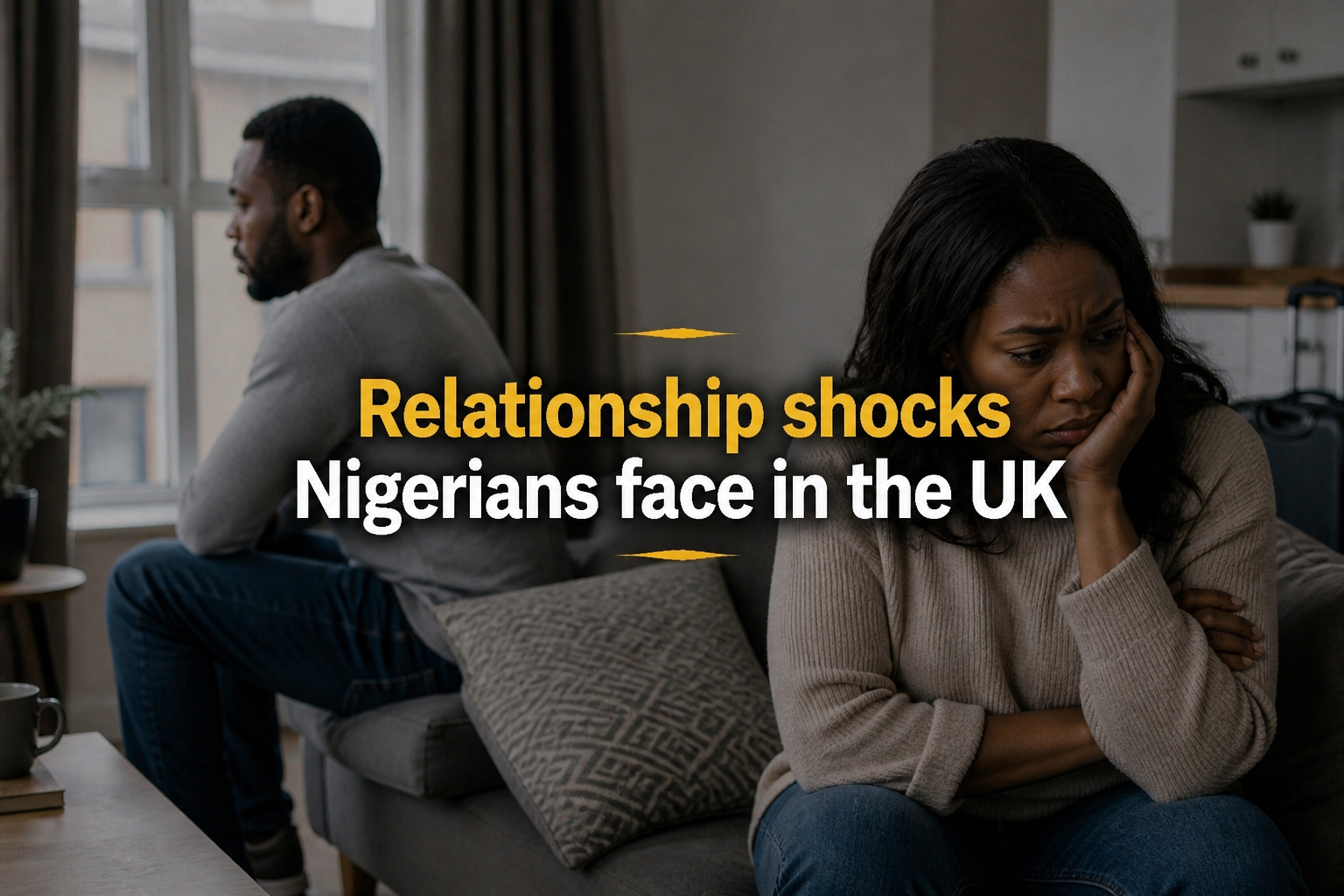
Nobody really warns you that when you relocate, it is not just your job, weather and accent that will change. Your relationships will also enter culture shock in ways that can feel quiet at first and then suddenly overwhelming.
People prepare for CV updates, IELTS exams and visa interviews, but very few prepare for the moment when “good morning” slowly turns into “we need to talk”, when friendships fade without any real argument, and when marriages begin to feel the weight of a life that looks nothing like the one you left behind.
This is the part of relocation that is harder to post on Instagram. It is not theory. It is real people trying to hold on to connection while everything around them is shifting.
One of the first shocks many couples face is how quickly “we will face it together” meets the reality of UK life. Back in Nigeria, routines can be predictable, support systems are closer, and even when life is stressful, there are familiar structures holding things up. In the UK, long shifts, childcare, and bills that never pause can quietly push couples into survival mode. Two people who once laughed easily can start living like colleagues sharing responsibilities instead of partners sharing life.
Then there is the shift in gender roles, which often arrives without warning. In Nigeria, many relationships follow a familiar rhythm, even when both partners are working. In the UK, that structure is disrupted by necessity. There is no house help, childcare is expensive, and both partners often have to contribute financially and domestically in ways that feel unfamiliar. What used to be “normal” now has to be renegotiated, and those conversations can come with tension, pride, and sometimes hurt.
Money becomes louder in a way that surprises many people. Every bill is structured, every payment has a deadline, and there is little room for flexibility. At the same time, responsibilities back home do not disappear. Supporting family in Nigeria while managing life in the UK creates a financial stretch that can expose cracks in how couples communicate and make decisions. Conversations about spending, saving, and sending money home can quickly become emotional.
Relocation can also shift the balance of power in a relationship. The person who finds work first, the one whose visa is tied to the other, or the one who adapts faster to the system can begin to carry a different kind of influence. These shifts are not always spoken about, but they are felt. A partner who once felt secure in their role may suddenly feel uncertain, and that internal struggle can affect how they show up in the relationship.
Extended family influence does not disappear, it simply changes shape. Distance does not reduce opinions. Calls from home can carry expectations that do not always match UK realities. Advice that made sense in Nigeria can feel disconnected from the pressures of life abroad, yet it still holds emotional weight. This can create tension between couples who are trying to balance respect for family with the practical demands of their new environment.
Friendships also go through quiet transitions. The people you spoke to every weekend may slowly become names you intend to call but never quite find the time for. It is not always conflict that breaks these bonds, sometimes it is simply distance, time zones, and different life paths. At the same time, building new friendships in the UK can feel harder than expected. Life becomes a cycle of work and home, and turning casual interactions into meaningful relationships requires effort that many people do not have the energy for.
For those who are single, dating can feel like entering a completely different culture. Expectations are different, timelines are less defined, and conversations are often more direct about personal values and boundaries. What felt straightforward back home can feel confusing here, especially when people are not in a hurry to commit in the same way.
Cohabitation is another area where culture can clash. Living together before marriage is widely accepted in the UK, but for many Nigerians, it still carries strong cultural or religious weight. Navigating these differences requires honest conversations that go beyond attraction and into values, beliefs, and long term expectations.
Read Also: How Nigerian Couples Can Avoid Divorce After Relocating to the UK
Marriage itself can feel different in a place where leaving is more possible. In Nigeria, social pressure, financial dependence, and family expectations often keep people in difficult relationships. In the UK, there are more systems that support independence. This does not make separation easy, but it makes it more accessible, and that reality can change how people think about staying or leaving.
Parenting adds another layer of complexity. Nigerian parenting styles often emphasise authority and discipline, while the UK approach leans more towards emotional awareness and children’s rights. Parents can find themselves questioning their instincts while also trying to hold on to their values. Children adapt quickly, sometimes faster than their parents, and that gap can create tension at home.
Time and energy also reshape relationships in subtle ways. Without the support systems many people had in Nigeria, daily life becomes more demanding. Work, commuting, cooking, cleaning, and childcare can leave very little space for connection. Romance becomes something that has to be planned rather than something that flows naturally.
Over time, people themselves begin to change. Exposure to new ideas, independence, therapy, and different social norms can lead to personal growth that does not always happen at the same pace for both partners. When one person evolves faster than the other, it can create a gap that needs to be bridged with patience and understanding.
Faith can either bring people closer or highlight differences. Some find strength in spirituality during the pressures of relocation, while others begin to question beliefs they never examined before. These shifts can influence how people see themselves, their roles, and their relationships.
Not every relationship survives these changes. Some end quietly, others more painfully. There is a grief that comes with losing connections that once felt permanent. It is a part of the migration story that many people carry privately.
And yet, many Nigerians also find ways to rebuild. Honest conversations, supportive communities, counselling, flexibility, and giving each other grace can make a difference. Some relationships emerge stronger, shaped by the very pressures that once threatened to break them.
The truth is that the UK does not create problems that were never there, it reveals them under a different kind of pressure. It removes some of the structures that once held things together and replaces them with a system that requires more intentional effort.
If you are experiencing these relationship shocks, you are not alone. What you are feeling is part of a larger story that many Nigerians in the UK are living through, even if they do not always say it out loud.
At Chijos News, we tell the real stories behind the relocation journey, not just the wins, but the quiet struggles that shape who we become abroad. For Nigerians in the diaspora, especially here in the UK, relationships are not just personal, they are part of the migration experience itself. If you see your story in this, you are not alone. This is our shared reality, and together, we are learning how to build lives, love, and community in a place that continues to challenge and change us.