
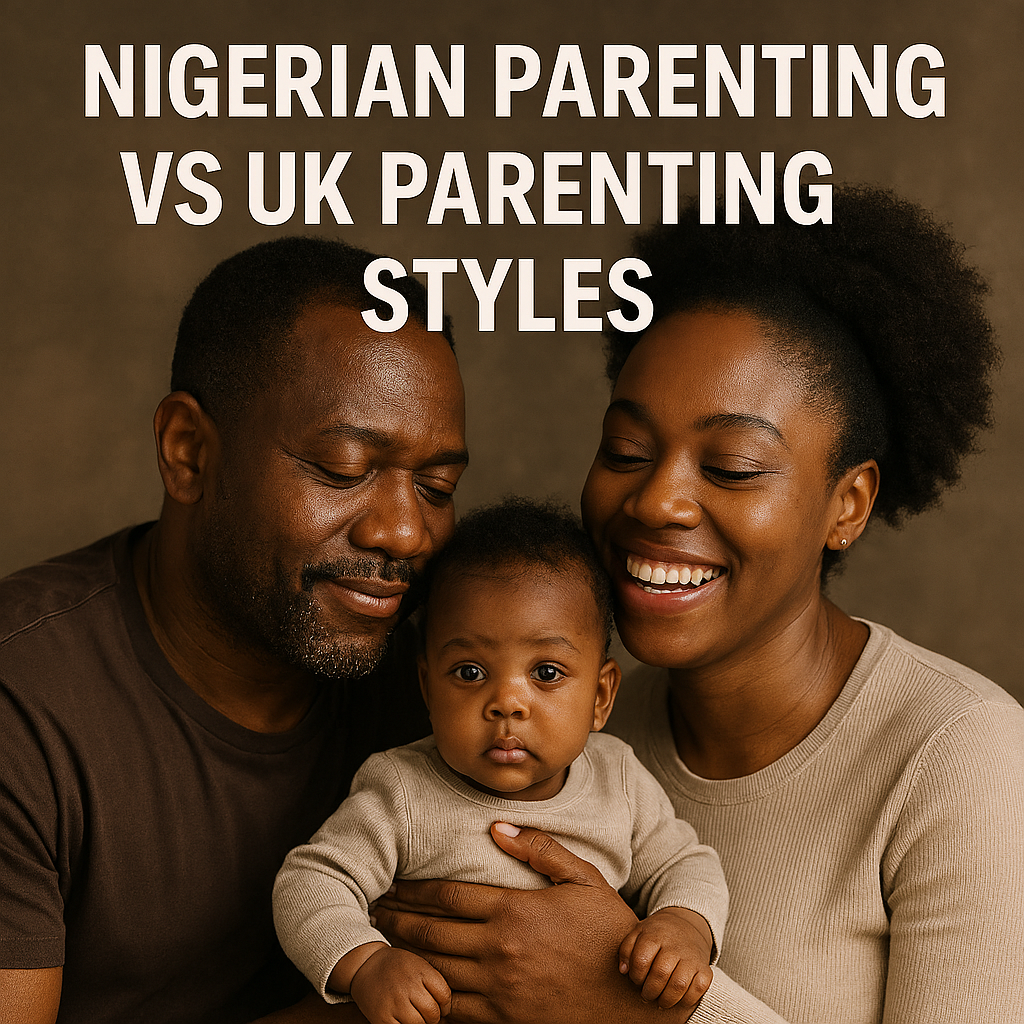
Across living rooms in London, Manchester, Birmingham and beyond, many Nigerian families are quietly navigating a parenting tension that doesn’t always make headlines but shapes everyday life. Children raised between Nigerian culture and British society often grow up learning two very different rulebooks, sometimes without anyone clearly explaining how the two are meant to fit together.
At Chijos News, we tell the stories that sit in this in-between space, where diaspora families are building lives, raising children and negotiating identity across borders. Parenting is one of the most emotionally charged parts of that journey. What feels like love, discipline and responsibility in a Nigerian home can be interpreted very differently within UK schools, safeguarding systems and social expectations. The result is confusion, fear, guilt and, at times, conflict on both sides of the parent-child relationship.
Nigerian parenting and UK parenting often appear like opposites that somehow share the same children. On one side are values rooted in respect, hierarchy and endurance. On the other are ideas shaped by emotional expression, safeguarding and independence. Underneath the stereotypes and jokes, however, both styles are driven by deep concern for a child’s future, safety and success.
This article explores how these two approaches differ, where they overlap, what happens when they clash in diaspora homes, and how Nigerian parents in the UK can adapt without feeling like they are abandoning who they are.
At the heart of every parenting culture is a simple question: what does it mean to raise a good child? In many Nigerian households, a good child is one who shows respect to elders, listens without arguing and understands their place within the family structure. Greeting properly, using titles like “sir” and “ma”, helping with chores and representing the family well in public are all seen as signs of good upbringing. Resilience is also central. Children are expected to endure hardship, push through discomfort and accept that life is not always gentle. Responsibility is taught early, often through caring for younger siblings or contributing to household duties. Underneath all of this is the belief that a child is being prepared not just for themselves, but for family and society as a whole.
UK parenting, by contrast, tends to focus on raising an individual rather than an extension of the family unit. A good child is often seen as someone who can express themselves confidently, form independent opinions and understand their emotions. Children are encouraged to speak up, ask questions and participate in decision-making. Emotional wellbeing is treated as a priority rather than a side issue, with feelings viewed as important information rather than distractions. The aim is to raise someone who is self-reliant, emotionally aware and comfortable asserting boundaries.
This difference alone creates tension. One system values quiet obedience as respect, while the other often rewards confidence and assertiveness. Nigerian parents in the UK frequently worry that British parenting styles will make children rude or entitled, while children raised in UK schools may struggle to understand why speaking up at home is treated as disrespect.
Authority and obedience are another major dividing line. In many Nigerian homes, parents are the unquestioned authority. Instructions are not usually open for debate, and “talking back” is often seen as one of the clearest signs of poor upbringing. Obedience is closely linked to humility and gratitude, and many parents believe a certain level of fear helps children stay in line.
In the UK, authority is often exercised through explanation rather than command. Parents still set rules, but children are usually encouraged to understand why those rules exist. Negotiation and discussion are seen as teaching tools rather than threats to authority. Obedience matters, but blind obedience is less celebrated than the ability to think critically and express disagreement respectfully.
For Nigerian families in the UK, this creates a daily contradiction. Children are taught at school to share their views and question ideas, but at home they may be expected to stay silent and comply. Over time, this can lead to confusion, resentment or a split identity, where children behave one way at home and another everywhere else.
Discipline is where cultural differences become most sensitive and, in the UK context, potentially risky. Many Nigerians grew up with physical discipline as a normal and accepted part of parenting. Spanking, slaps or the use of belts and slippers were often framed as acts of love meant to correct behaviour early and prevent worse consequences later in life. Discipline was usually immediate and sometimes public, reinforcing the seriousness of wrongdoing.
In the UK, physical punishment is heavily discouraged and closely monitored. Safeguarding systems are active, and children are taught that certain forms of discipline should be reported. Schools, healthcare workers and neighbours are legally required to raise concerns if they believe a child may be at risk. Discipline is expected to rely on non-physical methods such as loss of privileges, structured consequences and calm but firm conversations.
Many Nigerian parents only realise how strict these boundaries are after a frightening encounter with school authorities or social services. What feels normal within Nigerian culture can be interpreted as abuse in the UK, leading to investigations and long-term stress. This leaves parents asking how to maintain discipline and authority without crossing legal and social lines they may not fully understand.
Emotional expression is another area where misunderstandings easily arise. Nigerian parenting has traditionally prioritised toughness over vulnerability. Children are often taught to suppress tears, avoid complaints and focus on endurance. Emotional struggles may be minimised, spiritualised or compared to worse situations elsewhere, with the intention of building strength and gratitude.
Read Also: The Hidden Weight of Success Abroad: What Many Nigerians in the Diaspora Are Carrying in Silence
UK parenting, on the other hand, treats emotions as central to a child’s development. Children are encouraged to name how they feel, talk openly about anxiety or sadness and seek support when they are struggling. Mental health services, counselling and therapy are more visible and less stigmatised, particularly in schools.
In diaspora homes, this can lead to painful disconnects. A child who talks about anxiety or identity struggles may be met with fear or dismissal from parents who were never taught the language of emotional vulnerability. Parents may feel accused or blamed, while children may feel unheard and withdraw further, even though both sides are acting from love and concern.
Community also plays a very different role. Nigerian parenting is deeply communal, with extended family members and even neighbours often involved in correcting or guiding a child. A child’s behaviour reflects on the entire family, and decisions are frequently shaped by collective opinion. In the UK, parenting is more private and centred on the nuclear family. Outside interference is limited, but the state plays a stronger role in stepping in when concerns arise, something that can feel intrusive or shocking to Nigerian parents.
Education and success further highlight the contrast. For many Nigerian parents, academic excellence is not optional but essential, seen as the safest route to stability, respect and survival. Careers in medicine, law or engineering are often prioritised, while creative or vocational paths may be dismissed as risky. In the UK, success is defined more broadly, with greater acceptance of varied career paths and stronger emphasis on mental wellbeing alongside achievement.
Children raised between these worlds often become highly adaptable but emotionally stretched. They learn when to be quiet and when to speak, when to hide parts of themselves and when to express them. Some thrive in this duality, while others struggle with guilt, confusion or resentment, especially if open conversation is discouraged at home.
For Nigerian parents in the UK, adaptation does not have to mean losing cultural values. Respect, discipline and responsibility can coexist with listening, explanation and emotional awareness. Authority does not disappear when parents explain their reasoning, and structure does not vanish when physical punishment is replaced with consistent consequences. Understanding UK systems, especially safeguarding expectations, protects families from unnecessary harm and conflict.
UK society, too, can learn from Nigerian parenting, particularly its emphasis on community, resilience and respect for elders. A balanced approach recognises that no single culture has all the answers.
At its core, both Nigerian and UK parenting are driven by the same hope: to raise children who are safe, grounded and capable of building a better future. The challenge for diaspora families is not choosing one style over the other, but learning how to translate love across cultural languages. When that happens, children are no longer forced to live between worlds. Instead, they learn how to stand confidently in both.