
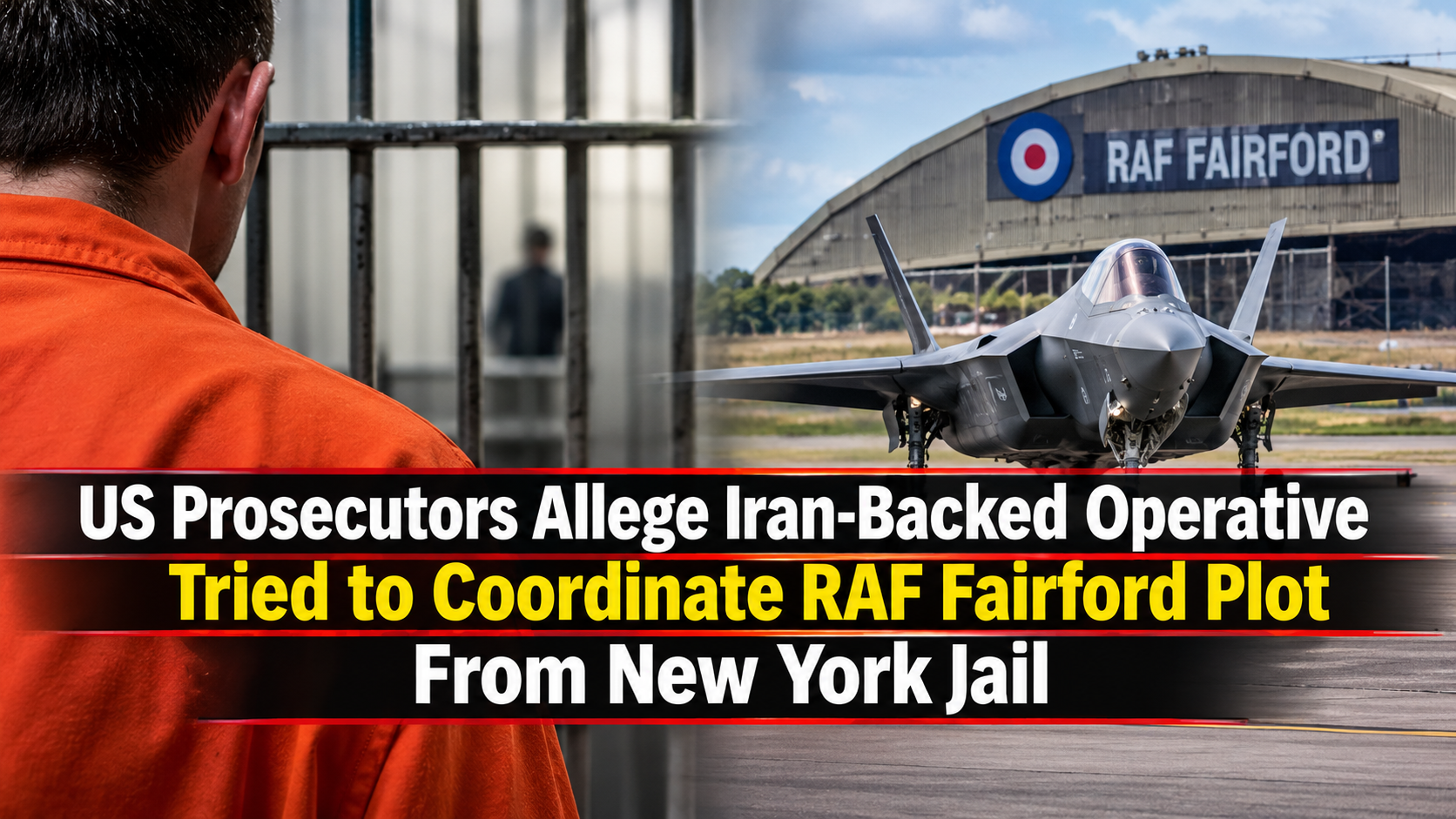
A man accused of links to an Iran-backed militia allegedly attempted to help coordinate a suspected terrorist plot targeting RAF Fairford in Gloucestershire while being held in a New York prison, according to newly released US court documents.
The US Department of Justice announced on Tuesday, 10 November 2026, that three men had been charged in connection with alleged terrorist activities across Europe and the United States, including a suspected plot targeting the British Royal Air Force base.
One of the defendants, Mohammad Baqer Saad Dawood al-Saadi, a dual Iranian-Iraqi national, is accused of using telephone conversations with close family members in Iraq to pass coded messages to two alleged associates, Mohsen Mohajeri and Mohammad Ali al-Hassani. Prosecutors claim the messages were intended to help coordinate activities connected to the RAF Fairford plot while al-Saadi was detained in the United States.
The allegations form part of an eight-count superseding indictment unsealed in federal court in New York. US prosecutors say the three men were involved in a wider network linked to Kata’ib Hezbollah and Iran’s Islamic Revolutionary Guard Corps (IRGC), organisations designated as terrorist organisations by the United States.
The defendants have not been convicted of the newly alleged offences. Al-Saadi had previously pleaded not guilty to the charges against him, and his lawyers have challenged the prosecution’s interpretation of conversations that investigators say contained coded instructions.
What prosecutors allege happened at RAF Fairford
RAF Fairford, located in Gloucestershire in south-west England, has been used by the United States military and was hosting American aircraft and personnel around the time of the suspected plot. The base has also been used by US bombers involved in military operations against Iran.
According to the US indictment, the alleged plot took place in September 2026 and involved a plan to move three vans towards the perimeter of the military installation. Prosecutors claim that al-Hassani, who was allegedly in Iran at the time, directed individuals in the UK to drive the vehicles towards the base.
Some of the vans were reportedly found to contain barrels of fuel, while investigators say the vehicles had been fitted with business-style logos intended to make them appear connected to commercial delivery operations.
The indictment states that at least two of the vans encountered a security checkpoint and were prevented from continuing along their intended route. British authorities subsequently recovered three white vans and arrested individuals connected to the incident in the early hours of 27 September.
US prosecutors allege that al-Hassani maintained contact with the drivers and helped direct their movements before and after they encountered the security roadblock. The investigation is examining whether the suspected operation was intended to cause an attack at the base and how the alleged participants were organised.
How the suspect allegedly communicated from a US prison
One of the most significant aspects of the US allegations concerns how al-Saadi allegedly continued communicating with people outside prison while awaiting trial in New York.
According to prosecutors, he used telephone and video calls with his mother and sister, who were in Iraq, to relay information to Mohajeri and al-Hassani. Investigators allege that the family conversations contained coded references to the two men, including the use of alternative names and phrases that prosecutors believe referred to terrorist activities.
Court documents describe conversations in which al-Saadi allegedly referred to Mohajeri using names including “Abbas, Abu Daniel” and “Sayyid Abbas”. Prosecutors also claim he discussed money owed to Mohajeri and asked family members to pass messages about “work”, a term they say he had previously used when discussing terrorist activity.
In another conversation dated around 24 September, prosecutors allege that al-Saadi asked about al-Hassani, whom he referred to as “Ali”. After being told that Ali had been transferred to an international section, al-Saadi allegedly instructed relatives to provide him with money so that “we can do it”.
Prosecutors say this exchange took place three days before the suspected incident at RAF Fairford. They argue that the conversations show al-Saadi was attempting to help coordinate the alleged operation despite being in custody.
However, the interpretation of these calls is disputed. In a court filing dated 14 October, al-Saadi’s lawyers argued that the prosecution’s claims about coded language were speculative and relied on questionable translations from Arabic. They said the conversations highlighted by investigators could have ordinary explanations and rejected the suggestion that they demonstrated involvement in terrorist planning.
The competing interpretations are now part of the legal proceedings, and the allegations will need to be tested through the court process.
Three men charged over alleged terrorist activities
The US Justice Department’s announcement identified three defendants in the superseding indictment. Al-Saadi is a dual Iranian-Iraqi national who was already being held in the United States on terrorism-related charges. Mohsen Mohajeri is an Iranian national, while Mohammad Ali al-Hassani is an Iraqi national.
Prosecutors allege that the men operated in support of an Iran-aligned network connected to Kata’ib Hezbollah and the IRGC. The indictment also refers to nearly 20 attacks and attempted attacks across Europe and the United States, including incidents targeting Jewish communities and organisations.
The US authorities allege that the wider network was involved in organising or supporting attacks in several countries. These claims form part of the prosecution’s case and have not all been established through convictions.
Al-Saadi had previously pleaded not guilty to eight criminal counts, including conspiracy to provide material support to Kata’ib Hezbollah. The latest superseding indictment sets out further allegations concerning the RAF Fairford incident and the activities of the other two defendants.
A lawyer for al-Saadi declined to comment on the latest announcement, according to Reuters.
UK Government previously pointed to suspected Iranian involvement
The latest US allegations follow earlier statements by British Prime Minister Andy Burnham, who said in October that the suspected plot targeting RAF Fairford was highly likely to have been coordinated in Iran.
Burnham told Parliament that the British Government believed the Islamic Revolutionary Guard Corps was almost certainly behind the suspected operation. He said the incident formed part of wider concerns about hostile activity involving criminal networks and individuals operating on behalf of foreign interests.
Iran has denied involvement in the suspected plot and rejected accusations that it was responsible. Tehran has challenged the claims made by Western governments.
The US indictment now provides additional allegations about how prosecutors believe the suspected operation was organised, including the alleged roles of individuals based in Iran and the UK and the communications said to have taken place from a US prison.
However, the publication of an indictment does not amount to proof of guilt. The defendants are entitled to challenge the evidence against them, and the allegations must be established through legal proceedings.
Why RAF Fairford is strategically important
RAF Fairford is an important military installation in Gloucestershire and has a long-standing role in supporting United States Air Force operations. Its location and facilities make it particularly relevant to military activities involving American aircraft operating from the UK.
The base’s use by US bombers during operations against Iran has also placed it within a wider geopolitical context. The suspected September incident raised concerns about the security of military installations in Britain and the possibility that international tensions could create risks closer to home.
The investigation has also highlighted concerns about the use of networks operating across national borders. Prosecutors allege that individuals in different countries were able to communicate, exchange instructions and coordinate activities despite one of the suspects being detained in the United States.
For British authorities, the case raises questions about protecting military facilities, identifying potential threats and responding to suspected hostile activity involving overseas networks.
What happens next?
The three men now face the legal process in the United States, where prosecutors will have to present evidence supporting the charges. Al-Saadi’s lawyers have already challenged the prosecution’s interpretation of the phone conversations, making the reliability of translations and the context of those discussions important issues in the case.
The British investigation into the suspected RAF Fairford plot is also significant because the alleged operation involved people and vehicles on UK soil. Authorities will continue examining the circumstances surrounding the incident, the individuals involved and any potential connections to wider networks.
For now, the central allegations remain matters for the courts. The US Justice Department has set out its account of the suspected plot, but the defendants have not been convicted of the newly alleged offences.
What the RAF Fairford allegations mean for Nigerians and other diaspora communities in the UK
For Nigerians and other African communities living in Britain, the allegations are a reminder that international security developments can have consequences beyond the countries directly involved. RAF Fairford is based in Gloucestershire, and concerns about the security of military installations, overseas influence and potential attacks are relevant to communities living, working and raising families across the UK.
The case also highlights the importance of separating legitimate concern about national security from assumptions about people based on their nationality, religion or background. The allegations concern specific individuals and an alleged network. They should not be used to stigmatise Iranian, Iraqi, Muslim or other diaspora communities living peacefully in Britain.
For Nigerian families in the UK, particularly those living in the South West and surrounding areas, it is useful to follow verified updates from local police, the Government and other official authorities when security incidents occur. Unconfirmed claims circulating through WhatsApp groups and social media can create unnecessary fear, especially when investigations involve international politics and terrorism allegations.
The case also matters to diaspora professionals, business owners and community organisations because public discussion of foreign interference and national security can sometimes lead to wider scrutiny of international links, funding and overseas relationships. Understanding the distinction between lawful community connections and activities that may raise legitimate security concerns is important.
At Chijos News, we will continue reporting on developments affecting Britain’s security and the communities living here, with a focus on verified information, the legal process and the practical implications for Nigerians and other diaspora residents. As the RAF Fairford investigation develops, it is important that public safety remains central while individuals and communities are treated fairly and without collective blame.