
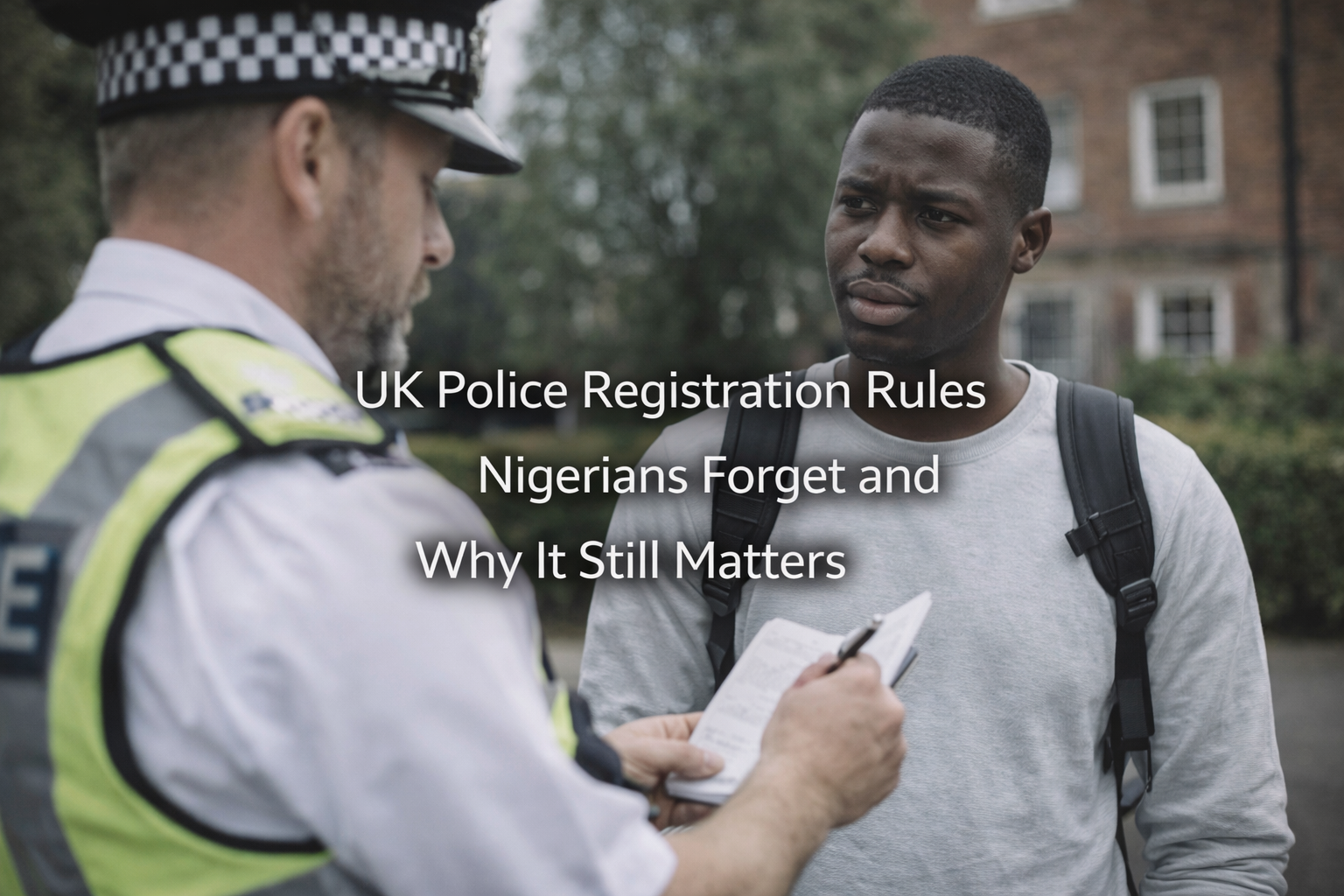
For Nigerians and other diaspora communities building their lives in the UK, immigration rules are not just paperwork, they are part of your long-term stability. At Chijos News, we focus on breaking down these complex systems into clear, relatable guidance that reflects real lived experiences. Many migrants are balancing work, studies, family responsibilities, and financial pressure, so it is easy for small requirements to slip through the cracks. But as many have learned the hard way, small details in immigration records can carry long-term consequences.
There was a time when police registration was a routine part of settling into life in the UK for many Nigerians, depending on visa type and immigration conditions. Although the scheme officially ended in 2022, its impact has not disappeared. For those who were required to register in the past, the record still exists, and in many cases, it can resurface during future visa applications, settlement processes, or background checks.
What often catches people off guard is not deliberate wrongdoing, but misunderstanding. Many Nigerians arrived in the UK focused on survival. They were juggling tuition fees, rent, long work shifts, and the emotional weight of starting over in a new country. In that reality, something like police registration did not always feel urgent. It was easy to assume it could wait, or that it was optional, or that someone else would explain it properly later.
In practice, it was never optional. For those whose visa required it, registering with the police and keeping those details updated formed part of their immigration conditions. This included changes to address, passport details, employment, or study status. What felt like routine life changes were, in the eyes of the system, updates that needed to be recorded.
Years later, many only realise the importance when they apply for another visa or indefinite leave to remain. That is when questions begin to appear. Why was your address not updated. Why does your certificate show outdated passport details. Why is there no record of registration at all. These questions are not always asked in a hostile way, but they do raise concerns about compliance.
The difficult part is that the system often works on records, not intentions. Someone may have moved houses multiple times as a student without updating anything, simply because they did not understand the requirement. Another person may have renewed their passport through the Nigerian High Commission and assumed that was enough. In real life, these are honest oversights. In immigration records, they can appear as gaps.
Read Also: UK Immigration Warning: Why You Must Update Your Address with the Home Office
There is also a deeper layer of confusion that still exists today. Even though police registration has ended, many people mix it up with other responsibilities such as updating their address with the Home Office, sponsor reporting, or conditions tied to specific visa routes. These are separate obligations, and misunderstanding them can lead to missed letters, delayed applications, or unnecessary complications.
For many in the diaspora, the emotional side of this cannot be ignored. Immigration processes can feel intimidating. Some people avoid engaging with official systems because of fear, past stress, or simply exhaustion. Others rely on advice from friends or community groups instead of official guidance, not out of ignorance but because that is what feels accessible and familiar.
The reality, however, is that immigration systems reward consistency and record-keeping. It is not about being perfect. It is about showing a pattern of responsibility over time. Even when a requirement like police registration has been removed, the expectation that you complied when it applied can still matter.
For those who know they may have missed something in the past, the most important step is not panic, but awareness. Many people have similar gaps in their records, and in most cases, they can be explained or addressed with the right guidance. What matters is understanding your situation clearly and taking steps to avoid repeating the same issues.
This is where mindset becomes important. Instead of seeing these requirements as unnecessary control, it helps to see them as part of protecting your own journey. Keeping your records accurate, responding to requests on time, and understanding what applies to you gives you more control in a system that often feels unpredictable.
For Nigerians in the UK, the journey is rarely simple. It involves sacrifice, resilience, and constant adaptation. Navigating immigration rules is just one part of that journey, but it is a part that can shape your future in very real ways. Staying informed, asking the right questions, and taking small administrative steps seriously can make the difference between a smooth process and a stressful one.
At its core, this is not about fear. It is about preparation. When you understand how the system works and where people commonly make mistakes, you are better positioned to avoid those pitfalls and move forward with confidence.