
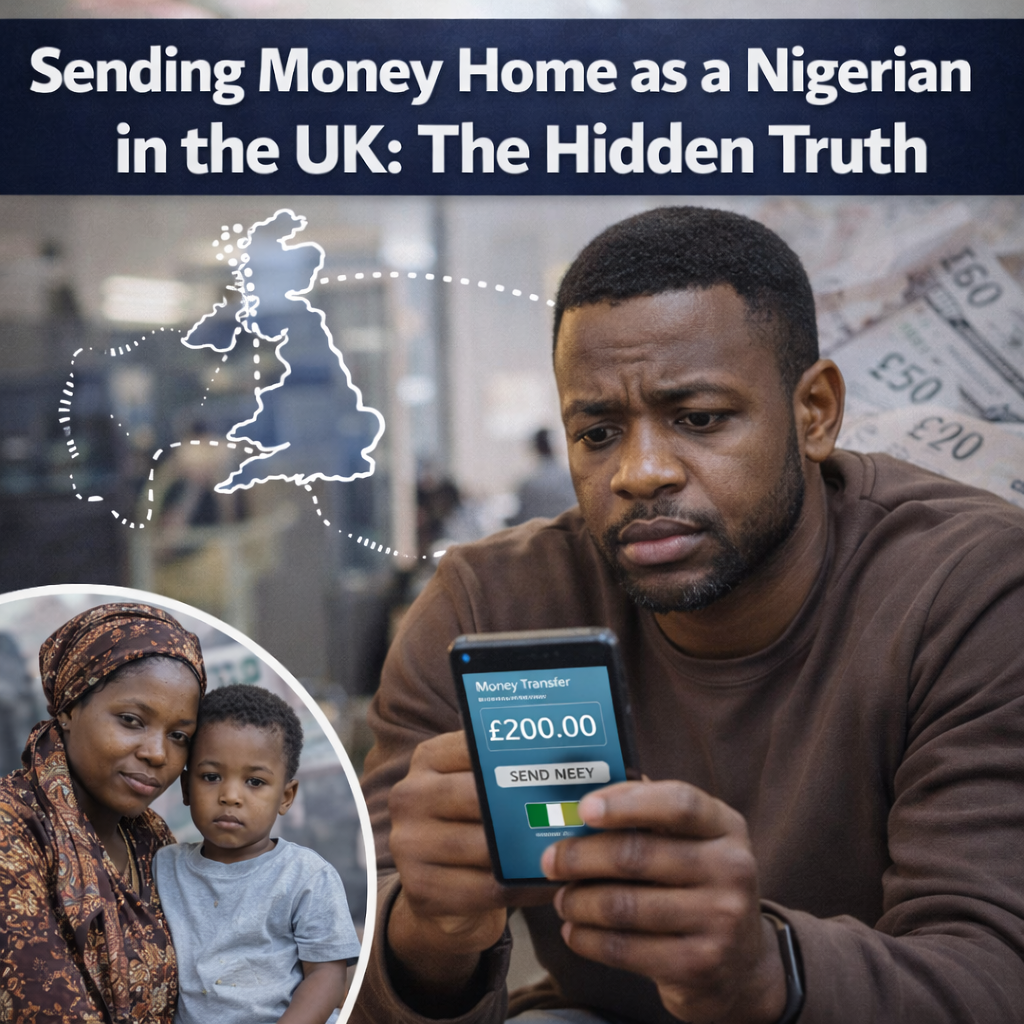
At Chijos News, we tell the stories many Nigerians abroad live but rarely say out loud. Stories that sit between pride and pressure, between progress and sacrifice. For Nigerians in the UK, sending money home is not just a financial decision; it is part of our identity, our upbringing, and our unspoken contract with family, faith, and home.
This is a story the Nigerian diaspora understands deeply. The joy of being able to help. The fear of not being able to keep up. The quiet anxiety behind every transfer alert. This article speaks directly to Nigerians in the UK who are building a life abroad while carrying the emotional and financial weight of home on their shoulders.
Sending Money Home as a Nigerian in the UK: Love, Pressure, and Survival
Sending money home is one of the most beautiful and brutal parts of the Nigerian diaspora story.
Beautiful, because it is love translated into action. School fees paid. Hospital bills settled. Food bought. Rent covered. Emergencies handled quietly from thousands of miles away. Brutal, because it is happening while rent in the UK is unforgiving, bills are relentless, and your own life is still under construction.
For Nigerians in the UK, saying “I will send something” is not just a promise. It is a responsibility. It is culture. It is expectation. And sometimes, it is a heavy weight on the chest when council tax, transport, groceries, visa fees, and savings are all competing for the same paycheck.
This is the reality many Nigerians abroad are navigating silently: balancing the high cost of living in the UK, the emotional and cultural expectation to send money home, and their own dreams, mental health, and long-term stability.
The Invisible Pressure Behind Every UK Payslip
On paper, a UK payslip looks straightforward. Gross pay comes in. Tax and National Insurance go out. What remains is your net pay.
In reality, that net pay is already divided before it even hits your account. Rent and bills in the UK take their share immediately. Food, transport, and everyday living costs follow closely behind. Then come debts, loans, visa fees, the NHS surcharge, and Home Office applications that quietly drain thousands over time. If there is anything left, you may try to enjoy life a little, or save for the future.
And then comes the unspoken line item. Sending money home.
Family in Nigeria often see pounds and imagine abundance. They see exchange rates, not expenses. They see opportunity, not overheads. What they do not always see is how quickly UK income disappears into rent, council tax, electricity, gas, water, transport, and food. They do not see the emotional tax of surviving in a system where missing one payment can damage your credit, your visa status, or your peace of mind.
So Nigerians in the UK live between two demanding worlds. One that takes a lot, and another that expects a lot. Standing in the middle, carrying both.
Why the Obligation to Send Money Home Feels So Heavy
The pressure to send money home is not just financial. It is emotional, cultural, and deeply spiritual.
Many Nigerians in the UK did not make the journey alone. Parents sold land. Relatives borrowed money. Church members contributed. Friends helped with proof of funds or accommodation. When you finally arrive and start earning in pounds, it does not feel like personal success. It feels like repayment. Like a collective investment that must now show results.
There is also the belief that being abroad automatically means being blessed. In many homes, “the one in the UK” becomes the emergency contact for everything. Hospital bills, school fees, rent crises, funerals, weddings, and family events all find their way to your phone. Not because people are wicked, but because in their minds, you are now the most capable.
Gratitude and guilt mix together. You are grateful for those who helped you. Guilty when you cannot meet expectations. So even when you are exhausted or financially stretched, you still say, “I will see what I can do.” That sentence has built homes, paid fees, saved lives, and quietly broken many people emotionally.
Where the Money Really Goes in the UK
To understand the strain, the reality of UK expenses must be spoken plainly.
Housing alone can swallow a frightening portion of income. In many UK cities, rent for a modest place can take half of a salary. Even house shares come at a high cost. Bills are non-negotiable. Council tax, electricity, gas, water, phone, and internet do not wait for explanations. Transport drains money through train fares, bus passes, petrol, insurance, and car maintenance. Food looks affordable in the supermarket until it adds up week after week.
Then there is immigration. Visa renewals, NHS surcharges, ILR applications, citizenship fees, and sometimes legal advice. Over the years, these costs run into thousands of pounds, quietly eating into savings.
On top of all this, you still have personal goals. Saving for a house deposit. Improving your skills. Supporting children in the UK. Paying off relocation debts. When someone says, “Just send £200, it’s small for you,” they are not seeing this full picture.
Read Also: Why Nigerians Confuse British Colleagues at Work – UK Culture Clashes Explained
The Emotional Conflict Nigerians Rarely Admit
Many Nigerians in the UK live in a constant emotional tug-of-war. If you help, you suffer quietly. If you don’t, you feel wicked, ungrateful, or disconnected from home.
This conflict shows up in small but heavy ways. Avoiding calls because you know how they will end. Feeling panic when a Nigerian number flashes on your phone late at night. Feeling shame when you genuinely do not have what is being asked for. Feeling resentment when people assume you are stingy, unaware that you are already stretched thin.
To cope, many people work extra shifts, sacrifice rest, push their health aside, and delay their own dreams. All to meet expectations that may never fully understand the cost.
How Nigerians in the UK Actually Try to Balance It All
Despite everything, Nigerians are resilient. Many find quiet ways to support home without completely losing themselves.
Some treat family support like a fixed bill, deciding on a monthly amount they can manage and sticking to it. Others learn to separate urgent needs from non-essential requests, contributing where it truly matters and setting boundaries elsewhere. Many slowly begin to explain the reality of UK life to their families, not to complain, but to give context.
Learning to say no without burning bridges becomes a skill. Offering partial support instead of full responsibility becomes necessary. In families with multiple earners, sharing responsibility helps reduce the burden on one person. Over time, some move from constant emergencies to more structured support, paying key bills directly or helping relatives build small income streams instead of relying on endless transfers.
When Sending Money Home Starts to Harm You
There is a point where generosity becomes self-neglect. When you are borrowing in the UK just to send money home. When you never save because every extra pound leaves immediately. When resentment builds silently. When your health suffers because you are always chasing money.
At that stage, something has to change. Burning out abroad does not help anyone in the long run. If you collapse financially or emotionally, your ability to support others disappears too.
Choosing Sustainability Over Guilt
The healthiest Nigerians in the UK learn to hold two truths at once. They honour their families while protecting their future. They accept that boundaries are not wickedness. That helping does not mean destroying yourself. That long-term support requires long-term stability.
They still send money. They still show up. But they also save, invest, improve their careers, and work towards security. They stop trying to fix everything and focus on building something that lasts.
Final Thoughts from Chijos News
Being Nigerian abroad comes with a unique emotional weight. You are carrying your own dreams, your family’s hopes, and the pressure of a struggling system back home. Sending money home is love. But love built on burnout does not last.
You are allowed to have limits. You are allowed to plan your giving. You are allowed to say, “I can’t this month.” You did not leave Nigeria to become a remote ATM. You left to build a life.
And when you build that life wisely, steadily, and with boundaries, your ability to help others does not shrink. It grows.
At Chijos News, we see you.

